In a professional audio project, the distance between the central equipment area and individual installation points can quickly increase the total cable requirement. A small system may only require a few meters of cable, while a project for an auditorium, church, school, performance venue, or other large facility may require hundreds of meters or more.
At this scale, cable estimation, procurement, transportation, and storage become important parts of the overall installation plan. Proper cable management from the planning stage can help contractors control costs, maintain installation progress, and reduce unnecessary material waste.
When a Project Requires Large Quantities, Treat Cables as a Dedicated Material Category
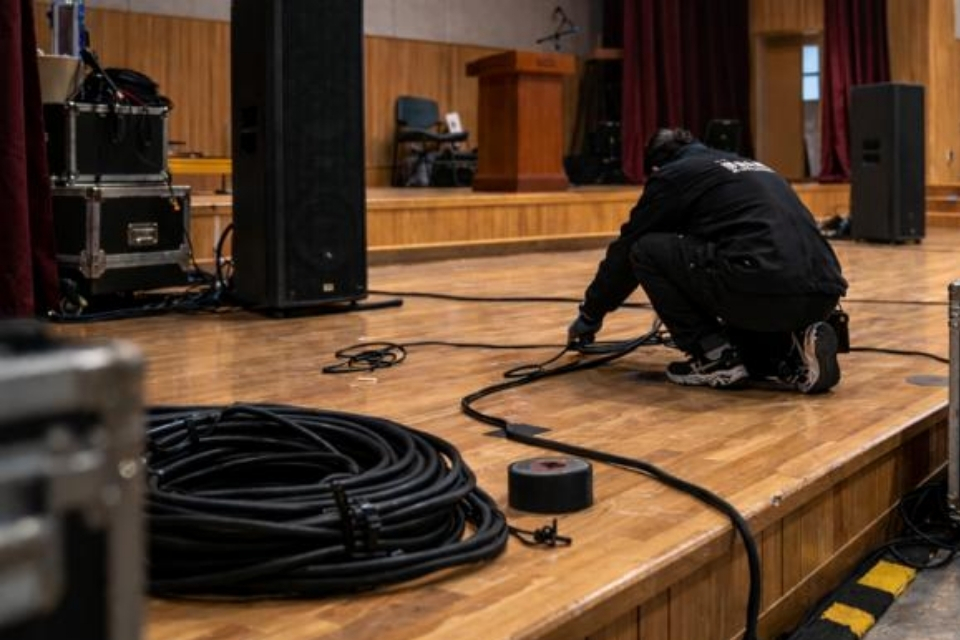
Cables should not be considered merely accessories that come with the main equipment. For large-scale projects, they should be treated as a separate material category that requires detailed planning and control.
Before placing an order, contractors should determine:
- Total length of each cable run.
- Cable type required for each connection.
- Number of cable runs.
- Appropriate allowance for additional length.
- Cable routing plan.
- Transportation and storage requirements at the project site.
Categorizing cables is particularly important. A project may require signal cables, speaker cables, network cables, and power cables at the same time. Calculating only the total number of meters without separating cable types can result in excess quantities of one category while another category is insufficient.
For projects requiring large quantities, cable supplied by the reel or by length can be a practical option. Contractors can prepare and cut cables according to the actual requirements of each run instead of relying entirely on pre-terminated or fixed-length cable assemblies.
How Much Cable Allowance Should You Include?
One of the most common challenges in cable estimation is finding the right balance between insufficient and excessive material.
If the calculation follows the drawing too closely, the installation team may run short when actual cable routing requires additional length due to site conditions or changes in the cable path.
On the other hand, excessive allowance increases the total material budget and may leave a large amount of unused cable.
A practical approach is to start with the project drawings and actual cable routes, then determine an appropriate allowance for each installation section.
The basic process can be summarized as:
Drawing → Define cable route → Measure length → Add appropriate allowance → Confirm total length → Select cable specification
Cable Reels Make Large Cable Runs Easier to Manage
When working with long cable runs, purchasing the cable is only one part of the process. Storage and transportation also need to be considered.
A large cable coil can become difficult to move, pull, and distribute across different installation areas if it is not properly managed. Cable reels provide a practical solution for winding, storing, transporting, and deploying long cable runs.
The ABCCabls product range includes cable reel solutions designed to support cable handling and management during installation.
For projects involving multiple long cable runs, reels can help with:
- Winding and storing cable.
- Transporting cable to the installation area.
- Pulling cable along individual routes.
- Reducing cable tangling.
- Collecting unused cable after installation.
For long cable runs in particular, establishing a cable management plan from the beginning can make the installation process more organized and efficient.
Don't Look Only at Cable Price - Consider the Total Deployment Cost

When purchasing cables in large quantities, the price per meter is an important consideration, but it should not be the only factor.
Contractors should also evaluate product availability, packaging, transportation, storage, and installation requirements. A cable option with an attractive unit price may still create additional costs if supply is inconsistent or the material is difficult to transport and deploy.
For this reason, working with a supplier offering a broad cable portfolio can make project material preparation more flexible.
ABCCabls offers multiple cable categories for Professional Audio systems and other connection requirements, making it a practical option for projects that require different cable types and large quantities.
Once the required cable lengths and specifications have been established, the next step is to prepare a complete material list to control quantities and the overall project budget.
Hoang Bao Khoa - ABCCabls Cable Supply for Large-Scale Projects

For projects requiring large quantities of audio connection cables, Hoang Bao Khoa supplies a broad range of ABCCABLS audio cables with available stock to support professional installations and project-based requirements.
Customers can select cable types, lengths, and quantities according to project drawings, system designs, or actual installation plans.
Hoang Bao Khoa also supports product consultation and project-based quotations. Large quantities of ABCCABLS audio cables are available to help contractors maintain supply continuity and installation schedules.
For projects requiring long cable runs or large quantities of cable, Hoang Bao Khoa also provides cable reels to support winding, storage, transportation, and deployment at the installation site.
Nationwide free shipping is also available, helping optimize transportation costs for large orders of audio cables and accessories.
This makes Hoang Bao Khoa a suitable source for contractors, Professional Audio installers, and projects requiring stable cable supply, diverse product options, and reliable delivery support.