Digital mixers provide flexible control, preset recall, and powerful signal processing, helping optimize the operation of professional audio systems.
What is a digital mixer and how is it different from an analog mixer?
For many years, analog mixers have been the standard in audio systems. However, the emergence of digital mixers has completely changed the way systems are approached and operated.
Analog mixer
- Manual control using physical knobs
- No ability to store configurations
- Highly dependent on the technician
Digital mixer
- Controlled via screen, software, or tablet
- Quick preset saving and recall
- Integrated signal processing (EQ, compressor, effects)
The core difference: Digital mixers transform audio systems from “manual operation” to “automation and flexibility”.
How do digital mixers change audio system operation?
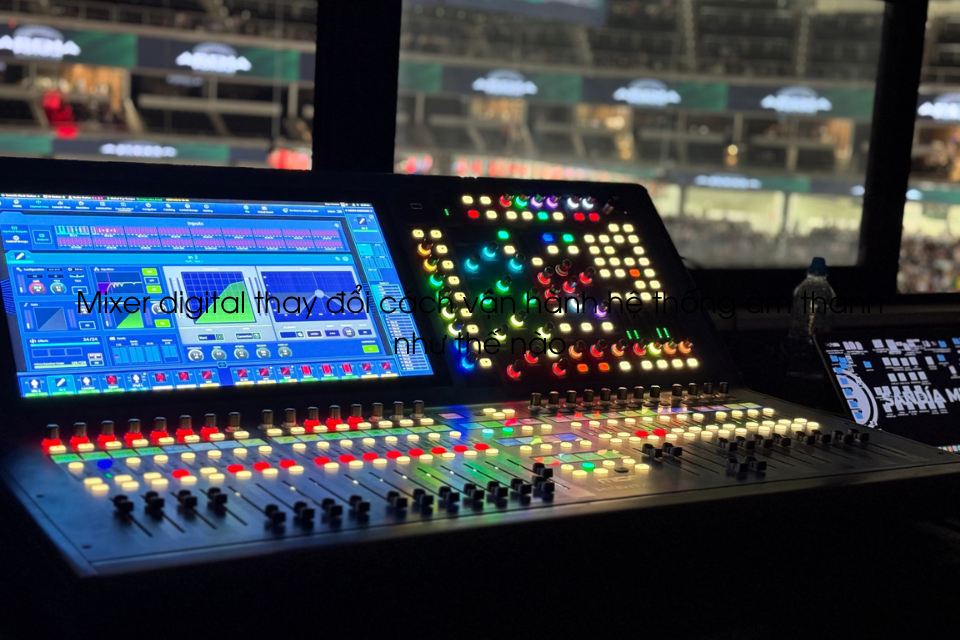
The transformation is not just about the device, but how the entire system is managed:
- Save and reuse configurations (Preset)
A system can store multiple setups for different scenarios such as conferences, performances, livestreams...
→ With one action, the entire setup can be restored
- Remote control - more flexibility
Technicians can control the mixer via tablet or laptop
→ Move around the space for more accurate listening and adjustments
- Reduce dependence on external devices
Digital mixers integrate EQ, compressor, reverb, delay...
→ No need for multiple external processors as before
- More scientific system management
Channels can be named, grouped, and routed clearly
→ Minimize errors in large systems
=> Digital mixers make audio systems faster, more accurate, and more professional.
Practical benefits of using digital mixers
In real environments such as halls, stages, bars, or studios, digital mixers bring clear advantages:
No need to reconfigure from scratch every time
Reduce preparation time for events
- Ensure consistent sound quality
Settings remain unchanged, minimizing variation
Ideal for fixed installations
Reduce the number of external devices
Cleaner system, easier maintenance
- Suitable for multiple applications
Conference halls, stages, churches
Acoustic cafes, bars, livestream setups
This is why digital mixers are becoming the standard in modern audio systems.
Suggested digital mixer options
Depending on your needs, you can choose digital mixers from reputable brands such as:
- Behringer X32, XR series: Popular, easy to use, suitable for many setups
- Midas M32 series: High-end quality with advanced audio processing
These models are widely used in real-world applications.
If you need consultation, you can refer to Hoang Bao Khoa – a professional provider of audio system solutions, ensuring the right equipment for the right needs.
Conclusion
A digital mixer is not just a new device, but a transformation in how audio systems operate.
- From manual control → to automation
- From complex setup → to optimized and flexible
- From experience-based operation → to structured system management
Switching to digital mixers helps audio systems achieve higher efficiency, greater stability, and a more professional performance.