Many churches invest in high-quality loudspeaker systems, yet congregants still report poor speech intelligibility in certain areas. In many cases, the issue is not caused by the equipment, but by loudspeaker placement. Based on experience in designing worship audio solutions, Hoang Bao Khoa has found that proper loudspeaker positioning can make a significant difference in speech clarity and overall listening experience.
The Goal of Church Sound Systems Is Not Loudness
When it comes to loudspeakers, many people tend to focus on power. However, for churches, the primary goal is not to produce high volume, but to ensure the congregation can clearly hear readings, sermons, and liturgical content.
A well-designed sound system should ensure:
- Even sound coverage across the entire space
- Avoidance of overly loud or overly quiet zones
- Clear speech intelligibility
- Reduced reverberation and echo
These factors are far more important than raw power specifications.
Common Mistake: Using Only One Speaker Pair for the Entire Church
In many older installations, the sound system consists of only one main speaker pair placed near the altar.
This setup may work for small chapels, but in long church buildings it creates significant issues.
People sitting near the speakers often experience excessive loudness, while those at the back struggle to hear clearly.
When volume is increased to compensate for distant areas, the front sections become uncomfortably loud, reducing overall worship experience.
Why Churches Need More Than One Speaker Cluster
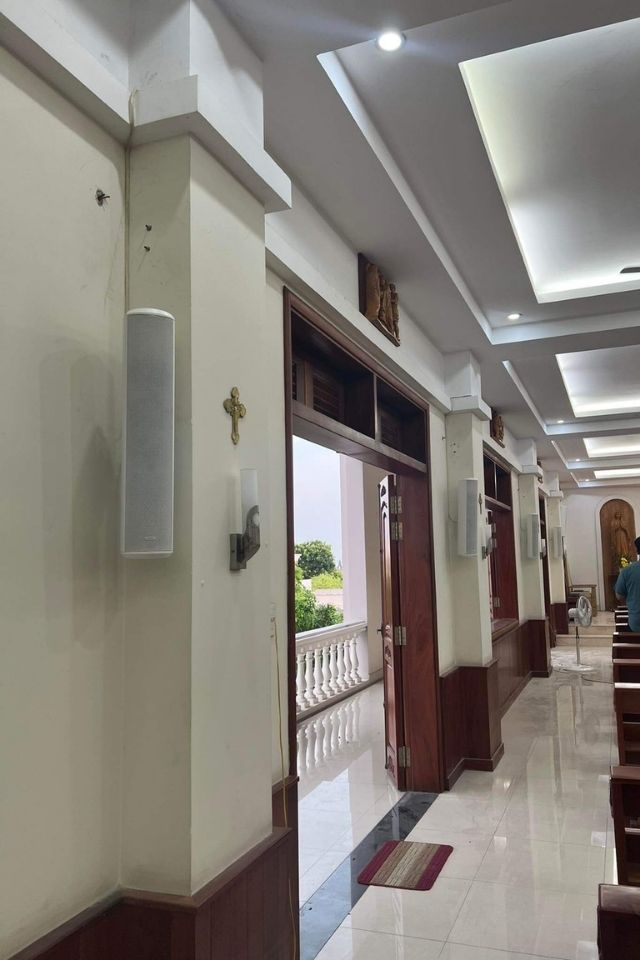
Sound naturally decreases over distance.
The farther from the source, the weaker the direct sound becomes, while reflected sound from walls and ceilings becomes dominant.
This is why modern churches often use additional distributed speaker clusters instead of relying solely on main speakers.
This approach provides:
- More uniform sound distribution
- Improved speech intelligibility
- Reduced load on main speakers
- Less need for excessive volume levels
This method is widely used in large or acoustically complex church buildings.
Are Column Speakers a Good Solution for Churches?
In recent years, column speakers have become increasingly popular in worship sound systems.
Their main advantage is better vertical sound control compared to many traditional speaker types.
This helps:
- Reduce sound reflections from ceilings
- Minimize unwanted acoustic reflections
- Improve speech clarity
However, not all churches are suitable for column speakers. Selection depends on space size, ceiling height, and architectural characteristics.
Speaker Placement Matters More Than Most People Think
During church audio system surveys, the Hoang Bao Khoa technical team often encounters systems using high-quality equipment but delivering suboptimal results due to improper placement.
Common issues include:
- Speakers installed too high
- Incorrect coverage angle
- Improper spacing between speaker clusters
- Lack of time alignment between zones
These factors directly affect speech intelligibility for the congregation.
TANNOY and FBT Speakers in Church Audio Solutions
For churches and chapels, speaker selection should prioritize speech clarity, coverage consistency, and long-term durability.
Many modern installations use TANNOY installation speakers due to their effective sound dispersion control and suitability for various architectural environments.
Additionally, FBT speakers from Italy are widely appreciated for stable performance, clear vocal reproduction, and reliability in worship environments.
According to hoang bao khoa’s experience, brand selection is only one part of the solution. Proper system design, installation, and tuning are even more important.
On-Site Acoustic Survey Is Essential
There is no universal formula for all churches.
Each building has unique characteristics such as:
- Floor area
- Ceiling height
- Construction materials
- Congregation size
- Architectural layout
That is why on-site acoustic surveys are essential before designing and installing any sound system.
Conclusion
An effective church loudspeaker system is not defined by high power or a large number of devices, but by its ability to distribute sound evenly and ensure speech clarity throughout the congregation.
When properly designed and combined with suitable equipment, the system allows everyone in the church to clearly hear liturgical content, improving both the worship experience and the sense of reverence during Mass.