Sennheiser MobileConnect is a real-time audio streaming system that delivers high-quality sound over Wi-Fi directly to smartphones, enabling assistive listening and live interpretation for conferences and events. In this article, Hoàng Bảo Khoa provides an in-depth look at how MobileConnect works, its practical applications, and the key advantages that make it a standout solution for modern venues.
Overview of Sennheiser MobileConnect
MobileConnect is a direct audio streaming system over WiFi developed by Sennheiser, allowing listeners to receive audio directly on their personal smartphones. This “audio over WiFi” technology is primarily designed for assistive listening while also supporting applications such as simultaneous interpretation, private listening channels, and dedicated audio distribution in auditoriums, theaters, meeting rooms, and convention centers.
Instead of relying on traditional receivers or handheld listening devices, MobileConnect operates on a “Bring-Your-Own-Device” model, enabling users to simply connect their smartphones to the venue’s WiFi network to access the assigned audio channel. This approach simplifies deployment, reduces operational costs, and delivers a more flexible user experience.
How MobileConnect works
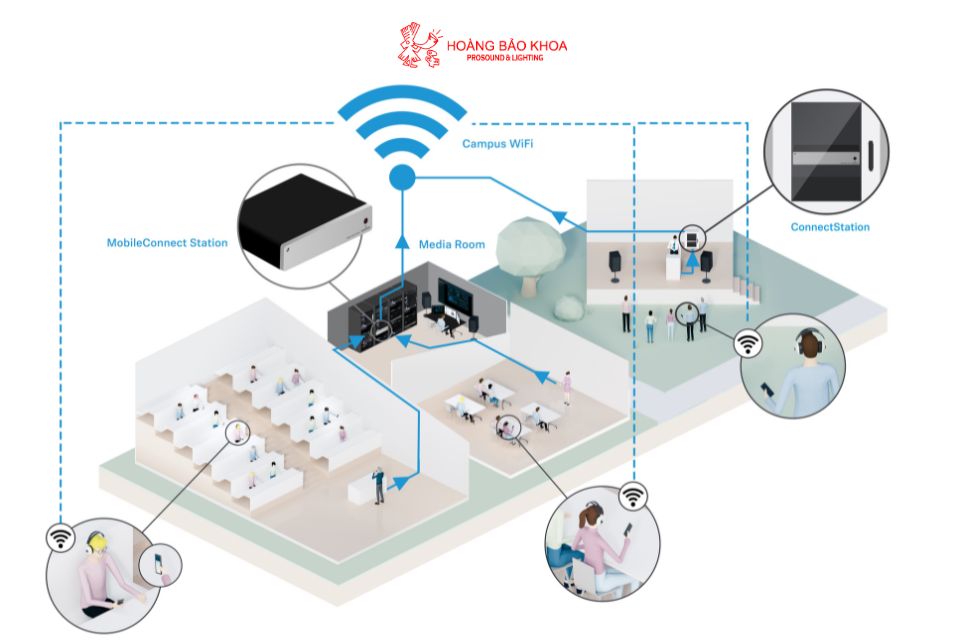
At the core of the system is the MobileConnect Station, which acts as the streaming server. The Station receives audio signals from mixers, microphones, or central processing systems through two connection types:
- DANTE over LAN (professional IP audio standard)
- Analog XLR when the infrastructure does not use DANTE
Once the audio is received, the Station converts it into digital streams and distributes them over the local LAN to WiFi access points. Users simply open the MobileConnect app on their phones, connect to the venue’s WiFi, and scan a QR code or select a channel to listen.
Supported listener capacity & audio channels
A single MobileConnect Station supports up to 100 simultaneous listeners. This number can be allocated to one or two channels depending on configuration. For example:
- 100 listeners on a single channel
- 60 listeners on channel 1 and 40 listeners on channel 2
- For more than 100 listeners, additional Stations can be added
Each Station provides 2 audio channels (mono or stereo), suitable for common setups such as native language – interpreted language, or main program audio – descriptive/assistive audio.
Benefits of the “bring-your-own-device” model
Using personal smartphones offers several advantages:
- Reduced investment cost: no need to purchase or maintain dedicated receivers.
- User-friendly: listeners use the interface they are already familiar with.
- High privacy: each person uses their own device and does not share headphones.
- Scalable: simply add more Stations or increase network bandwidth when the audience grows.
Network requirements for MobileConnect
MobileConnect does not generate its own WiFi; it requires a stable existing network infrastructure. For optimal performance:
- WiFi must be properly designed for high-density environments (enterprise-grade WiFi).
- Smartphones and the Station must be connected within the same LAN.
- A minimum bandwidth of 20 Mbps is recommended for 100 listeners.
Since it operates entirely on the local network, MobileConnect can function fully without Internet access — except when using advanced management features or performing updates.
Conclusion
MobileConnect is a powerful WiFi-based audio distribution solution that reduces hardware load, streamlines deployment, and excels in assistive listening, language interpretation, and Professional Audio distribution. With its flexible architecture, scalability, and smartphone-optimized operation, MobileConnect is a leading choice for modern auditoriums, public buildings, and shared spaces.
{SanPham}