For large-scale stages from outdoor concerts and major festivals to arenas and public squares audio requirements go far beyond sheer loudness. The sound system must deliver consistent coverage, precise control, and stable performance over long distances.
These evolving demands have driven line array loudspeakers to gradually replace traditional speaker configurations, establishing them as the industry standard for professional stage sound systems today. This article explores in detail the reasons behind the dominance of line array systems in modern live sound applications.
1. The modern stage landscape and new audio requirements
Today’s performance stages are becoming increasingly large and diverse, ranging from outdoor stages and public squares to arenas and music festivals hosting tens of thousands of attendees. Wide spaces, deep audience areas, and high crowd density place new demands on sound reinforcement systems.
Modern stage sound systems must not only be loud enough, but also ensure:
- Even sound coverage from the front rows to the furthest seats
- Controlled sound directivity to minimize reflections and noise
- High clarity and detail at elevated SPL levels
- Fast deployment, safe rigging, and suitability for touring
These requirements are exactly why line array loudspeakers have gradually replaced traditional point-source configurations as the industry standard.
2. What is a Line Array loudspeaker? how it differs from traditional systems
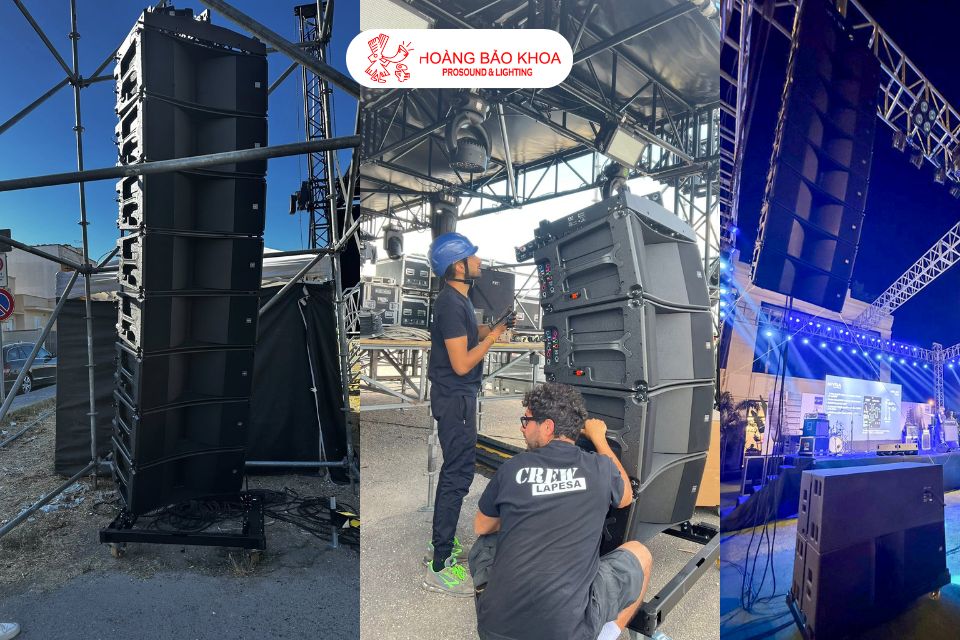
A line array loudspeaker system consists of multiple identical loudspeaker modules stacked vertically to function as a single coherent sound source. This principle allows sound WAVES to propagate in a cylindrical pattern rather than a spherical one, as is typical with single loudspeakers.
Quick comparison: line array vs traditional loudspeakers
- Line array: long throw capability, slower sound level attenuation over distance, precise control of sound directivity
- Full-range or single-box loudspeakers: suitable for small spaces, rapid level loss as distance increases
- Clustered individual loudspeakers: difficult phase alignment, higher risk of overlap and acoustic dead zones
In large venues, line array systems allow sound engineers to achieve far better coverage control and significantly reduce uneven sound distribution.
3. Key advantages that make Line Array the industry “standard”
3.1. Consistent sound coverage from near to far
Thanks to cylindrical WAVE propagation, line array systems significantly reduce volume differences between areas close to the stage and seats further back. Hot spots and dead zones are minimized, which is especially critical for deep stages and large audiences.
3.2. Directional control and reduced reflections
Each module in a line array can be set at a specific splay angle, allowing precise control over sound dispersion. This helps reduce unwanted reflections from ceilings, walls, or non-audience areas - an important advantage for both outdoor stages and large indoor venues.
3.3. High SPL with preserved detail
Line array systems are well suited for high-energy performances such as live music, EDM, and large concerts. Even at high SPL levels, they maintain vocal intelligibility and instrumental detail - an essential requirement for professional shows.
3.4. Optimized rigging and stage safety
Line array designs support flexible flying or ground-stacked configurations, reducing floor space usage while enhancing safety for performers, audiences, and technical crews. This is a key consideration for modern stage design.
4. The role of line arrays in modern stage sound systems
In a standard configuration, line arrays serve as the core FOH system, working alongside subwoofers, front-fill, and out-fill systems to ensure comprehensive coverage. Control is managed through DSP, amplifiers, and dedicated prediction software.
As a result, a Line Array is not merely a loudspeaker, it is an integral part of a complete sound reinforcement solution.
5. Real-world example: FBT MYRA line array in stage applications
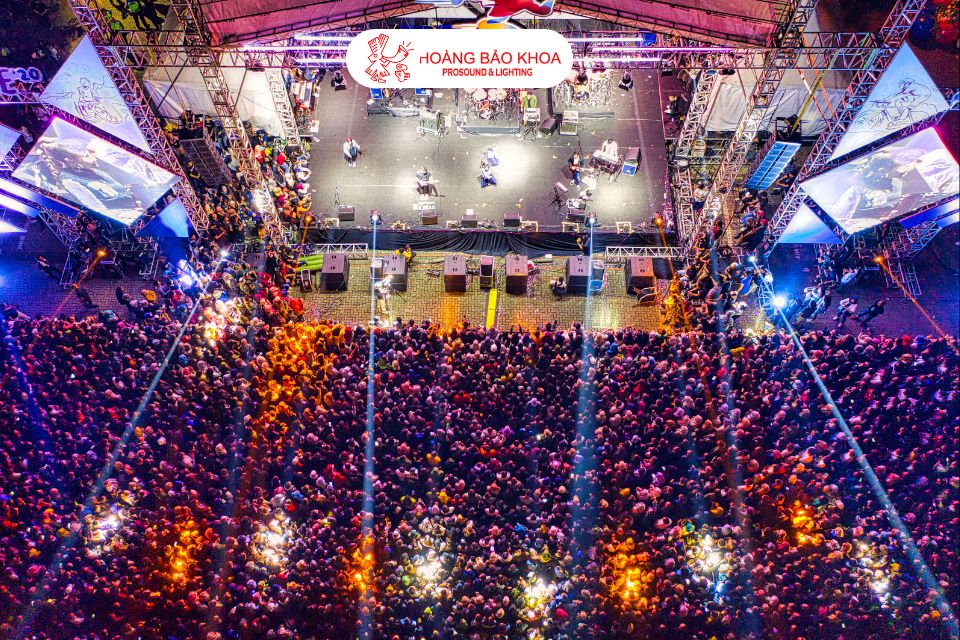
FBT MYRA is a representative example of the modern Line Array trend, developed for applications such as outdoor stages, festivals, large concerts, and sports arenas.
- High-performance line array modules
- Flexible array scalability to match different stage sizes
- Suitable for both touring and permanent installations
MYRA reflects a modern line array design philosophy: powerful output, precise control, and flexible configuration for each specific project.
6. Why professional consultation and deployment matter when using line arrays
A line array system does not automatically deliver optimal sound simply by being flown. Proper performance requires:
- Accurate coverage and splay angle calculations
- Correct module quantity based on stage scale
- System-wide DSP, delay, and phase alignment
The experience of a professional system integrator plays a decisive role in real-world performance results.
Hoàng Bảo Khoa not only supplies genuine line array equipment but also provides consulting and deployment services tailored to each specific stage scale. With hands-on experience in stage sound and event projects, Hoàng Bảo Khoa meets technical requirements while ensuring complete documentation, including CO and CQ certificates, along with committed support policies.
These solutions are well suited for event organizers, public square stage investors, and professional audio-visual contractors.
8. Conclusion
Line array systems are no longer a “premium option”—they have become an essential standard for modern stages. Consistent coverage, precise control, and high safety standards are the key reasons line arrays remain central to professional sound reinforcement systems.
Choosing the right system and the right consulting and deployment partner will largely determine the success of any live performance.