A common situation in many churches is that when congregants report that the sound is difficult to understand, the sound operator responds by increasing the volume level. However, after raising the volume, many people still find the speech unclear, and may even experience harshness or listening fatigue throughout the Mass.
This shows that the issue is not always insufficient volume, but rather the overall speech intelligibility of the sound system.
Louder Sound Does Not Always Mean Clearer Sound
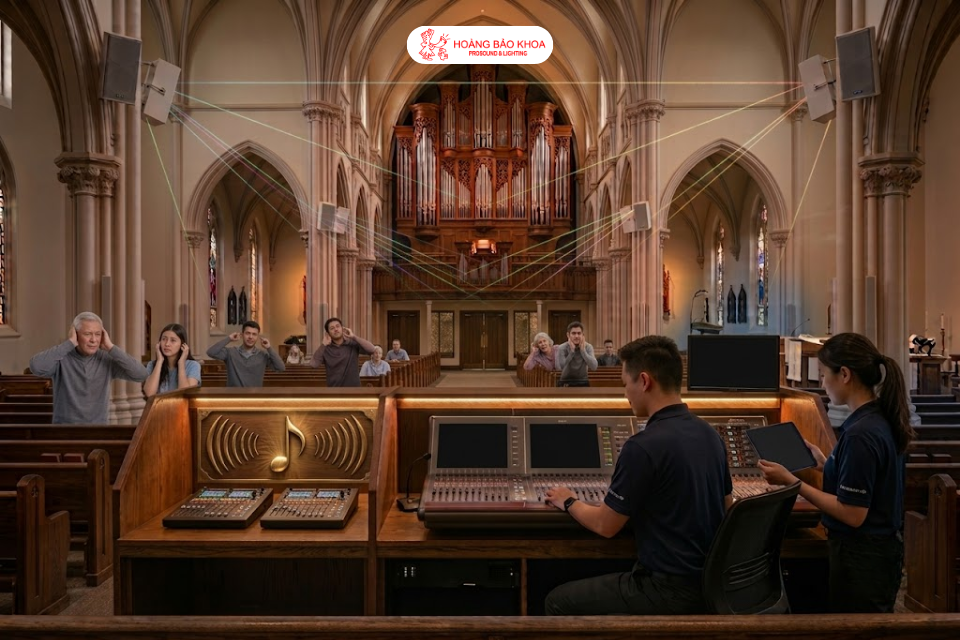
In a liturgical environment, the most important factor is not how loud the sound can be, but whether the congregation can clearly hear every reading, prayer, and sermon. If the volume is only increased without improving sound transmission quality, the audio may become louder but the message can still remain difficult to understand.
Some common signs include:
- People sitting near the speakers feel the volume is too loud but still cannot clearly understand the words
- The sound level at the back of the Church is significantly lower compared to the front area
- Voices become mixed with the natural reverberation of the space
- During choir performances, the lyrics become difficult to distinguish
These signs indicate that the issue is often related to sound coverage, speaker direction, or system calibration rather than simply a lack of power.
What Needs Improvement Is Not Always Volume
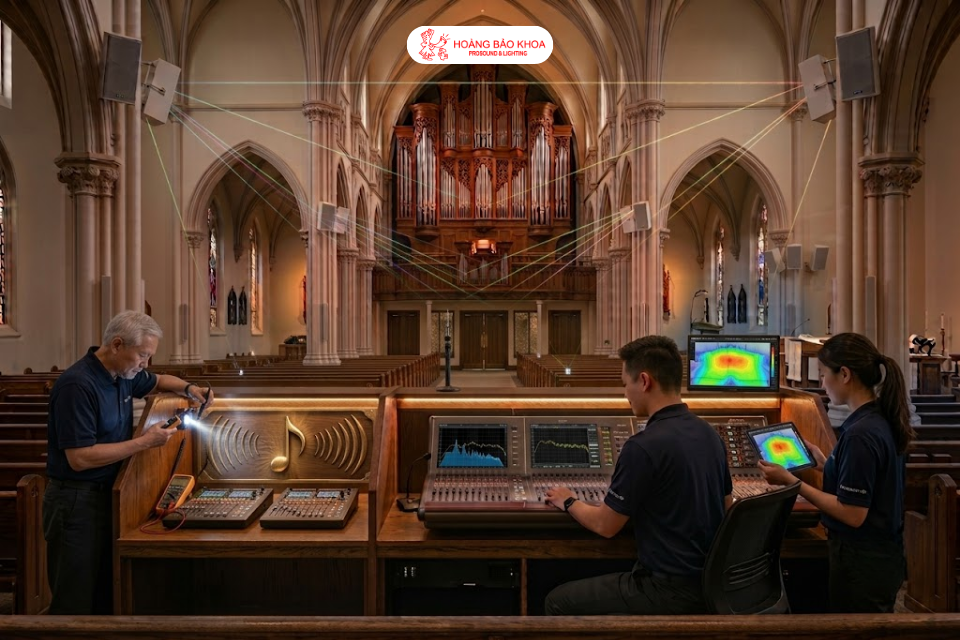
In many cases, increasing the volume by a few dB does not improve speech intelligibility. In fact, it can make sound reflections inside the Church become more noticeable.
An effective solution usually begins with a complete system evaluation:
- Is the sound distributed evenly throughout the entire space?
- Are the speaker installation positions suitable for the Church architecture?
- Are voices and liturgical music properly balanced?
- Can the current system still meet the needs of the congregation?
Only after identifying the exact cause can adjustments or upgrades bring real improvements. Some projects may only require system recalibration, while others may need speaker repositioning or additional equipment to improve sound distribution and speech clarity.
This is also why, in Church audio projects, Hoàng Bảo Khoa always begins with a site survey and system evaluation before proposing a solution. Each Church has different architecture, acoustic characteristics, and usage requirements, so there is no single configuration that works perfectly for every project.
Conclusion
When the congregation reports that the sound is “difficult to hear,” the first solution should not simply be increasing the volume. The more important step is identifying why the sound lacks clarity and addressing the actual cause.
An effective Church audio system is not the system that produces the loudest sound, but the one that allows the entire congregation to hear clearly, understand easily, and fully receive the message of every Mass.