In professional live sound and event systems, a line array’s performance depends not only on loudspeaker design but also heavily on the amplifier driving it. The right amplifier ensures system stability, precise control, clarity, and overall performance. Conversely, an improper choice can limit the entire system, regardless of the loudspeakers’ quality.
Amplifier Power and Compatibility with line array Systems
The first factor to consider is the compatibility between the amplifier and the speakers within the system.
The amplifier must deliver sufficient power to meet the requirements of each speaker module in the Line Array system. If the power is insufficient, the system will lack impact and may distort at higher output levels. On the other hand, excessive power without proper control can lead to overload and negatively affect the longevity of the speakers.
Professional amplifiers designed for large-scale systems help ensure stable operation, optimize performance, and maintain safety across the entire setup.
- Ensure appropriate power for each speaker module
- Avoid underpowering that causes distortion or overpowering that leads to overload
- Select amplifiers that match the system configuration
Signal Processing Capability and DSP Integration
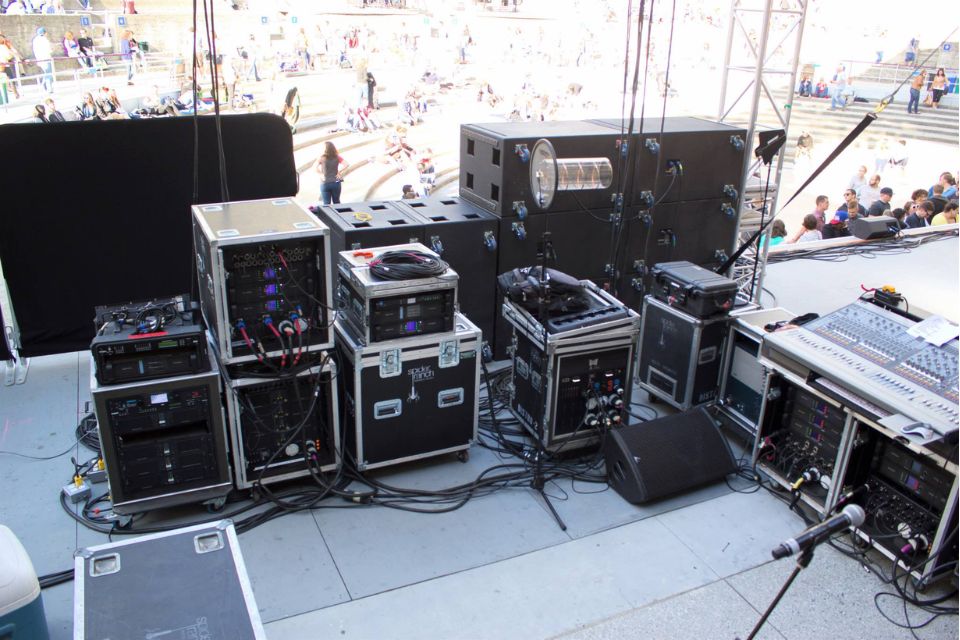
Modern amplifiers not only amplify signals but also play a key role in audio processing.
Amplifiers with integrated DSP allow users to configure crossover, EQ, limiter, and delay directly on the device, enabling precise optimization of the line array system while reducing reliance on external processing equipment.
Choosing an amplifier with suitable DSP capabilities helps control frequency ranges effectively, minimize distortion, and ensure even sound distribution throughout the performance space.
- Integrated DSP for on-board signal processing
- Precise setup of crossover, EQ, limiter, and delay
- Reduced dependence on external processing devices
Stability, Operation, and System Management
In real-world applications, amplifiers are required to operate continuously under high load, especially during live shows or outdoor events.
Therefore, heat dissipation, operational stability, and protection systems are critical factors. Amplifiers should include protection features such as thermal protection, overload protection, and short-circuit protection to ensure overall system safety.
In addition, network connectivity and remote control capabilities allow engineers to monitor and adjust the system in real time, which is particularly important for large-scale Line Array configurations.
- Ensure efficient cooling and stable operation
- Include comprehensive protection mechanisms
- Support flexible networking and remote control
Conclusion
Selecting an amplifier for a line array system is not just about specifications, but about balancing power, signal processing capabilities, and operational stability in real-world conditions.
- Balance power output with system control
- Optimize signal processing for consistent audio quality
- Ensure long-term stability and operational safety
A well-matched configuration enables the system to perform at its full potential, maintain consistent sound quality, and reduce risks during operation.
For systems requiring high precision, consulting with experienced solution providers can help optimize performance from the beginning and ensure long-term operational reliability.