One of the most common comments heard in many churches today is:
“The sound is there, but it isn’t clear.”
While this may seem like a simple issue, it has a direct impact on the quality of worship services. When congregants cannot clearly hear scripture readings or sermons, their ability to engage with and understand the message is significantly reduced, even though the sound system itself appears to be functioning normally.
What is particularly important to understand is that the problem is often not a lack of loudspeakers or amplifier power. In many cases, the system has already received substantial investment, yet it still falls short of its most important objective: delivering clear and intelligible speech to the entire congregation.
Speech Intelligibility Is the Most Important Measure
In live performance environments, audiences can experience music through melody, rhythm, and emotional expression.
However, in a church environment, most liturgical content is communicated through spoken words.
For this reason, the most important criterion of a church sound system is not volume level but the ability to reproduce speech clearly and intelligibly.
Listeners need to hear every sentence, every word, and fully understand the message being delivered. If the sound is loud but lacks clarity, the system has not achieved its intended purpose.
The Distance Between Speakers and Listeners Is Too Great
This is a common issue in churches with long sanctuaries or large interior spaces.
When a system relies solely on a pair of main speakers installed near the altar area, sound must travel a considerable distance to reach listeners seated at the back of the church.
During this process, direct sound gradually decreases as distance increases, while reflected sound from walls, ceilings, and surrounding surfaces becomes more dominant.
As a result, parishioners seated farther away may still hear the sound but struggle to understand the spoken content clearly.
This is why many church projects today incorporate supplementary loudspeakers or delay speaker systems to maintain speech intelligibility in areas located far from the primary sound source.
Microphones Not Suited to the Intended Application
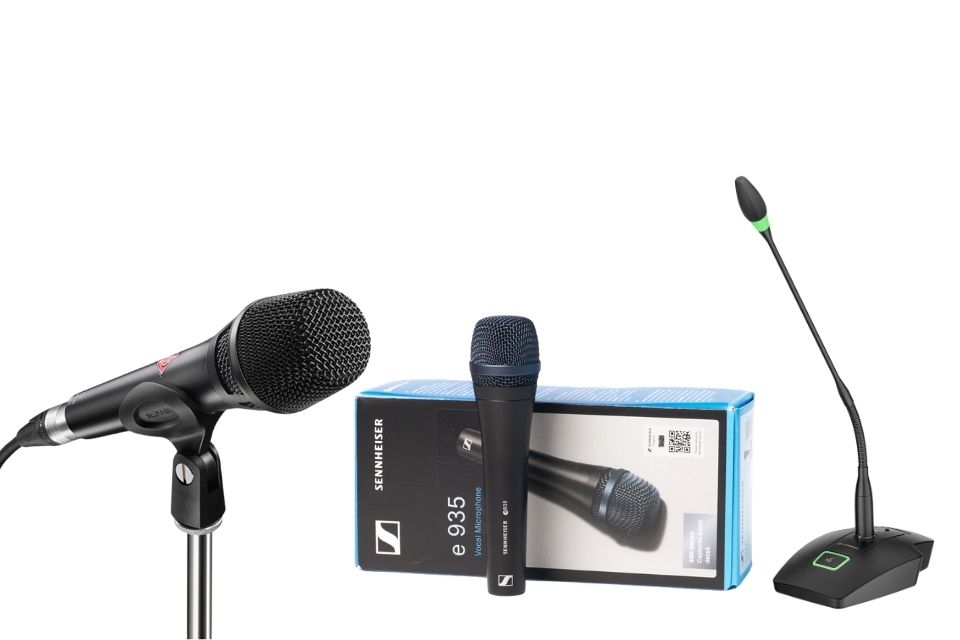
The Microphone is the first device in the audio signal chain and directly influences overall sound quality.
If the captured signal lacks clarity or contains excessive background noise, downstream equipment will have limited ability to significantly improve the signal.
For sermons and spoken-word applications, microphones should reproduce speech naturally, minimize unwanted noise, and provide reliable performance throughout the service.
Many parishes today choose wireless microphone systems from Sennheiser combined with Neumann KMS capsules because of their ability to deliver detailed, natural, and highly intelligible speech, even in reverberant spaces.
Reverberation Reduces Speech Separation and Clarity
The architectural characteristics of churches often create longer reverberation times compared to many other types of buildings.
While this contributes to a sense of spaciousness and reverence within the worship space, it also presents significant challenges for sound system design.
When reverberation time becomes excessive, syllables begin to overlap, making it difficult for listeners to distinguish individual words and sentences.
In practice, many sound systems are perceived as lacking clarity not because of poor loudspeaker quality, but because the audio solution was not properly designed for the acoustic characteristics of the building.
Improper System Tuning and Optimization
A common mistake is putting the sound system into operation immediately after installation without performing detailed tuning and optimization.
EQ configuration, feedback control, signal level adjustment, and delay alignment between speaker zones all have a direct impact on real-world listening performance.
Even premium audio equipment may fail to deliver its full potential if the system is not carefully optimized according to the acoustic conditions of the venue.
Choosing Speakers Based on Power Rather Than Coverage Performance
Many people prioritize speaker power ratings when investing in a sound system.
However, in church applications, uniform coverage and precise control of sound dispersion are far more important factors.
A properly distributed system using multiple strategically positioned speakers often provides better speech intelligibility than a small number of high-powered loudspeakers.
This is one reason why professional installation loudspeakers such as TANNOY systems and FBT solutions are frequently selected for projects that require consistent and highly intelligible speech reproduction.
Conclusion
When parishioners have difficulty understanding sermons, the causes are often a combination of factors including building architecture, loudspeaker placement, Microphone selection, and overall system optimization.
An effective church sound system should not only provide adequate volume but also ensure that spoken content is delivered clearly and consistently to the entire congregation.
This remains the primary objective of modern worship audio solutions, enabling every member of the congregation to fully receive and understand the message communicated during each Mass and liturgical celebration.