Churches with high-ceiling architecture often create a sense of grandeur and reverence, making them visually impressive worship spaces. However, they also present some of the most demanding acoustic challenges. Many parishes invest in new loudspeaker systems, yet congregants still report difficulty understanding sermons and scripture readings. In most cases, the issue is not related to loudspeaker power, but rather to the acoustic characteristics of the building itself.
What Challenges Do High Ceilings Create for Church Sound Systems?
Sound does not travel only directly from the loudspeakers to listeners. It also reflects off surfaces such as walls, columns, and ceilings.
In churches with high ceilings, the distance between the speakers and the ceiling is greater, while the reflective surface area is also larger. As a result, sound continues bouncing around the space before it fully dissipates.
This means that listeners hear not only the direct sound but also multiple layers of reflected sound arriving afterward.
When excessive reflections occur, speech intelligibility can be significantly reduced.
Reverberation Is One of the Main Reasons Congregations Struggle to Hear Clearly
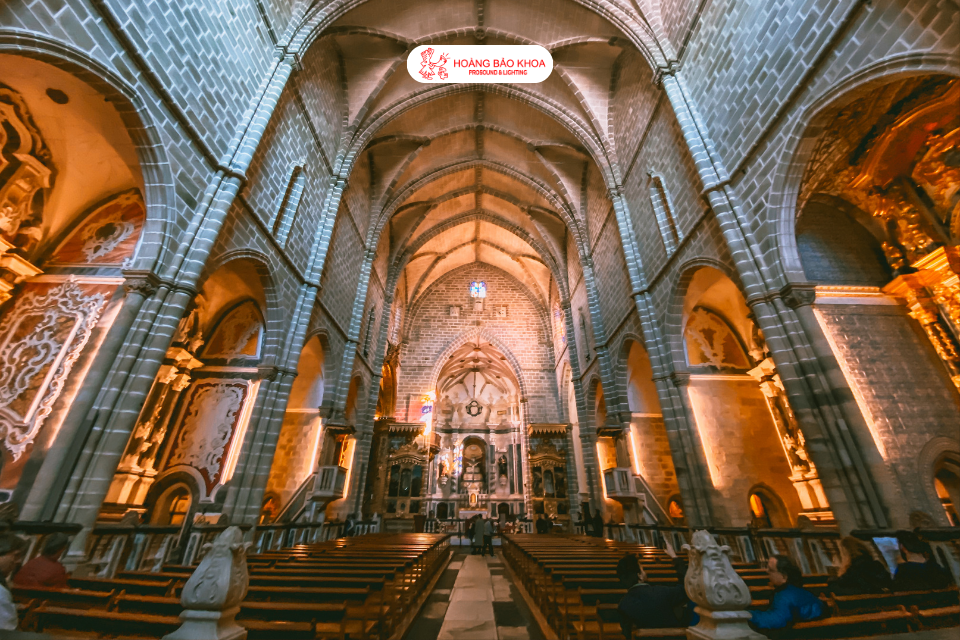
One of the most common acoustic issues in churches with high ceilings is reverberation.
When the priest or lector speaks, the sound continues reflecting throughout the space for a period of time. If the reverberation time is too long, later words begin to overlap with earlier ones.
As a result, people can still hear sound, but understanding spoken content becomes much more difficult.
This is why many churchgoers often describe the experience as:
- Loud but unclear
- Audible but difficult to understand
- Echoing or reverberant sound
In many situations, increasing the volume does not solve the problem and may actually make it worse.
Why Increasing Speaker Power Is Not the Solution
When speech becomes difficult to understand, the first reaction is often to increase the system volume.
However, in highly reverberant environments, increasing power also increases the amount of reflected sound throughout the space.
It is similar to trying to speak louder in a room filled with echoes. The volume rises, but speech clarity does not necessarily improve.
That is why Professional Audio designers focus on controlling sound direction and optimizing coverage rather than simply increasing system power.
The Role of Loudspeakers in High-Ceiling Churches
For churches with high ceilings, selecting the right loudspeaker system is extremely important.
An effective system should provide:
- Even sound coverage throughout the congregation area
- Reduced sound projection toward the ceiling
- A higher ratio of direct sound reaching listeners
- Less unnecessary reflected sound
This is why many modern churches utilize dedicated installation loudspeakers or column speakers instead of relying solely on traditional stage speakers.
Based on Hoang Bao Khoa's installation experience, selecting the correct speaker type often delivers far greater improvements than simply upgrading system power.
Speaker Placement Is Just as Important as Speaker Selection
Even when high-quality equipment is used, audio performance can suffer if the loudspeakers are not installed in the correct locations.
Common installation mistakes include:
- Mounting speakers too high
- Aiming speakers toward the ceiling
- Positioning speakers too far from the audience
- Failing to use supplemental speakers for rear seating areas
These issues reduce the amount of direct sound reaching listeners and make reverberation more noticeable.
DSP Can Help Optimize System Performance
In addition to selecting suitable loudspeakers, digital signal processors (DSPs) play an important role in improving church audio quality.
DSP technology can help with:
- Frequency equalization
- Speech intelligibility enhancement
- Delay alignment between speaker zones
- Reducing the risk of audio feedback
However, DSP cannot replace proper system design.
A well-designed and properly installed sound system remains the most important foundation for long-term performance.
Acoustic Assessment Should Come Before Equipment Investment
Every church has unique architectural characteristics.
Ceiling height, construction materials, the number of columns, building length, and congregation capacity all influence sound propagation.
Therefore, before purchasing new equipment or upgrading an existing system, an on-site acoustic assessment is essential to accurately identify the causes of audio problems.
At hoang bao khoa, every church audio consultation begins with evaluating the actual environment rather than focusing solely on equipment specifications.
Conclusion
Churches with high ceilings often face challenges in achieving excellent speech intelligibility due to complex acoustics and extended reverberation times. In many cases, the issue is not a lack of speaker power but rather the way the sound system is designed and installed.
Selecting appropriate loudspeakers, positioning them correctly, and optimizing the system according to the building's acoustic characteristics can significantly improve speech understanding for the congregation. These factors are essential for creating an effective, reliable, and long-lasting church sound system.
```