During church sound system assessments and consultations, one of the most common questions we receive is:
“Why do congregants at the back of the church still struggle to hear clearly, even after investing in a high-power sound system?”
This is not an isolated issue. In reality, many churches and chapels experience situations where the sound is loud enough, yet speech intelligibility remains poor. Worshippers can hear sound coming from the loudspeakers, but often have difficulty clearly understanding scripture readings, sermons, or spoken messages.
The reason is simple: the goal of a worship sound system is not to achieve high volume levels, but to ensure that every member of the congregation can clearly understand every word being delivered.
The Biggest Challenge of Church Sound Systems Is Speech Intelligibility
Unlike live performance venues or entertainment events, church sound systems must prioritize clear and accurate speech reproduction.
No matter how meaningful a sermon may be, its value can be diminished if the congregation cannot fully hear and understand the message being delivered.
In Professional Audio, this factor is known as Speech Intelligibility.
Simply put, the more clearly a sound system allows listeners to distinguish every word and sentence, the more effective the communication becomes.
This is also a far more important criterion than loudspeaker power when designing a church sound system.
Why Do Churches Often Suffer From Excessive Reverberation?
Most churches are built with architectural characteristics such as:
- High ceilings
- Long and spacious interiors
- Concrete or stone walls
- Numerous sound-reflective surfaces
These factors significantly increase reverberation time within the space.
When a priest or lector speaks into a Microphone, the sound does not travel only directly to the audience. It also reflects repeatedly from surrounding surfaces.
If these reflections persist for too long, new sounds overlap with previous ones, making speech seem echoed, muddy, and difficult to understand.
This is why many churches have functioning loudspeaker systems, yet the congregation still struggles to clearly follow the sermon.
Higher Power Does Not Necessarily Mean Better Clarity
A common misconception is that increasing volume will improve intelligibility.
In reality, within highly reverberant environments, increasing sound pressure levels simply generates even more reflected sound energy.
Instead of improving speech comprehension, excessive volume can often make messages harder to understand.
That is why professionally designed church sound systems focus on uniform sound distribution rather than merely increasing output power.
Speaker Placement Matters More Than Speaker Power
Many church installations rely on a single pair of main loudspeakers positioned near the altar to cover the entire sanctuary.
While this approach may reduce initial costs, it often creates significant differences in listening experience throughout the venue.
People seated close to the speakers may find the sound excessively loud, while those farther away may still struggle to hear clearly.
A more effective solution is to design the system according to the actual architectural characteristics of the building.
Depending on the venue, additional solutions may include:
- Delay speakers
- Column speakers
- Dedicated installation loudspeakers
- Zoned sound coverage systems
These solutions help distribute sound more evenly and significantly improve speech intelligibility throughout the space.
Choosing the Right Loudspeakers for Worship Applications
Not every loudspeaker is optimized for church environments.
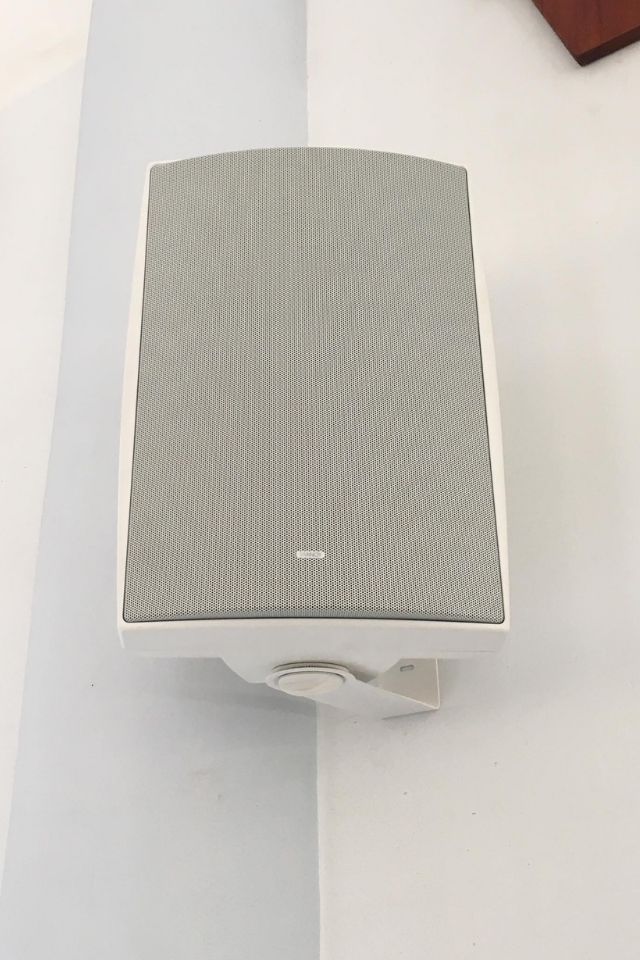
For venues requiring exceptional speech clarity, professional installation speakers often deliver better performance thanks to their controlled coverage patterns and accurate midrange reproduction.
This is one reason why many church sound systems today utilize installation solutions from TANNOY or FBT for areas requiring consistent coverage and reliable sound quality.
The most important factor is not which brand is considered the best, but whether the chosen equipment suits the architecture and practical requirements of the facility.
Microphones Also Directly Affect Speech Intelligibility
In addition to loudspeakers, microphones represent the first critical link in the audio signal chain.
For choir applications, high-quality wired Microphones can capture vocals naturally while minimizing feedback issues.
For sermons and spoken word applications, many churches prefer wireless microphone systems from Sennheiser paired with Neumann KMS capsules due to their detailed, natural, and highly intelligible voice reproduction.
At lecterns and pulpits, gooseneck microphones remain a popular choice thanks to their focused pickup characteristics and elegant appearance.
Conclusion
If the congregation struggles to understand sermons clearly, the issue is often not insufficient loudspeaker power but rather the overall sound system design.
An effective church sound solution should be developed based on several important factors:
- Architectural characteristics of the building
- Room reverberation time
- Speaker placement strategy
- Appropriate Microphone selection
- Audio signal optimization
When all these elements are properly integrated, the sound system does more than simply play louder. It enables the congregation to hear more clearly, understand messages more completely, and preserve the reverence and solemnity essential to every worship service.