Many people assume that simply choosing high-quality loudspeakers is enough to solve all sound-related issues in a church. However, in reality, loudspeaker placement is just as important as equipment selection. Even a high-end speaker system can deliver poor performance if installed in the wrong locations. Conversely, a properly designed layout can significantly improve speech intelligibility, reduce feedback, and enhance long-term system efficiency for the congregation.
Why Is Speaker Placement Important?
Sound is not only emitted from the speaker to the listener’s ears.
In a Church, sound is constantly reflected by:
- Ceiling
- Walls
- Architectural columns
- Glass and other hard surfaces
If speakers are not positioned correctly, reflected sound can become stronger than direct sound, causing echo, reverberation, or unclear speech for the congregation.
This is why in many Church sound system projects, site surveys are conducted before selecting equipment.
Do Not Mount Speakers Too High
This is a very common mistake.
Many people believe that the higher the speaker is mounted, the further the sound will reach.
In reality, when speakers are installed too high:
- Sound is easily directed toward the ceiling
- Increases sound reflections
- Reduces speech clarity
- Creates unnatural sound for nearby listeners
Especially in churches with high ceilings, mounting speakers too high often worsens reverberation issues.
Do Not Aim Speakers Directly at the Ceiling
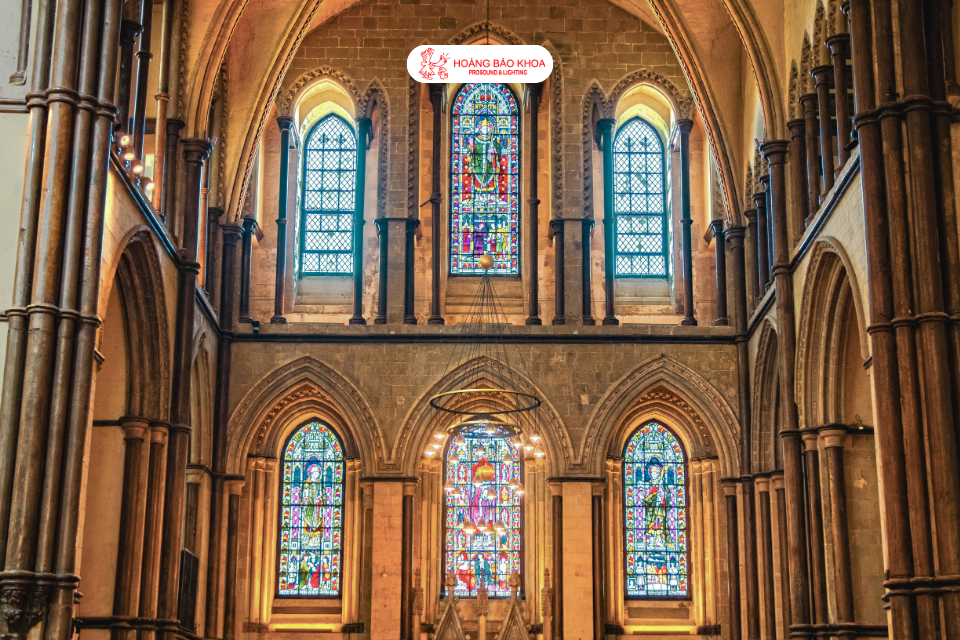
Some installations have incorrect speaker angles, causing sound to hit the ceiling or roof instead of the congregation area.
When this happens:
- Sound energy is wasted
- Speech clarity decreases
- Reflections increase
The goal of a Church sound system is to deliver sound to the audience, not to the building structure.
Do Not Place Speakers Too Close to Microphones
This is a common cause of Microphone feedback.
When sound from the speakers returns to the microphone and is continuously amplified, the system produces unpleasant squealing or feedback noise.
Key sensitive areas include:
- Pulpit area
- Main celebrant area
- Choir area
In many installations, proper coordination between Sennheiser wireless microphones, Neumann KMS capsules, and speaker placement significantly reduces feedback without heavy system processing.
Do Not Place All Speakers at the Front of the Church
This is a common mistake in long church buildings.
When only front speakers are used:
- Front listeners hear too loudly
- Rear listeners hear too softly
- Engineers are forced to increase volume
- Speech clarity decreases
For long churches, delay speakers or auxiliary speakers provide a much better solution.
This ensures even sound distribution across the congregation.
Do Not Place Speakers Behind the Speaker
Sound coming from behind a Microphone user increases the risk of feedback.
This is especially important for:
- Main celebrant (priest)
- Lector (reader)
- MC or announcer
If speaker placement is not properly designed, feedback can occur even with high-quality Microphones.
Do Not Choose Placement Based Only on Aesthetics
Aesthetics are very important in church architecture.
However, hiding speakers completely or placing them in unsuitable positions just for visual reasons can significantly reduce sound quality.
A good system must balance:
- Architectural aesthetics
- Sound coverage
- Speech clarity
- Maintenance accessibility
This is why TANNOY installation speakers are often chosen for church projects due to their balance between design and performance.
Good Speakers Still Fail If Placed Incorrectly
Many churches invest in high-quality speakers but are still not satisfied with the result.
Common causes include:
- Incorrect coverage angle
- Improper placement
- Lack of delay speakers
- Improper system tuning
In many worship audio projects, Hoang Bao Khoa evaluates the entire space before recommending TANNOY or FBT speaker solutions to ensure real-world performance rather than focusing only on specifications.
What Does an Effective Church Sound System Need?
Besides speaker placement, a complete system requires coordination of multiple components:
When these elements are designed as a unified system, sound quality improves significantly.
Conclusion
Choosing good speakers is important, but placement is the key factor that determines system performance. Proper positioning improves speech clarity, reduces reverberation, and enhances the listening experience for the congregation.
For church and chapel projects, on-site surveys before installation are essential to select the right speakers, correct placement, and proper system design. This is also the approach used by Hoang Bao Khoa when consulting worship sound solutions today.