After learning about delay loudspeakers, many parishes often ask: if additional loudspeakers have already been installed in the middle or rear sections of the church, why is a DSP still necessary? In reality, delay loudspeakers are only the physical part of the solution. The DSP is what ensures the entire system operates in sync, delivering the speech intelligibility and coverage required throughout the congregation.
DSP Helps Multiple Speaker Zones "Speak in the Same Rhythm"
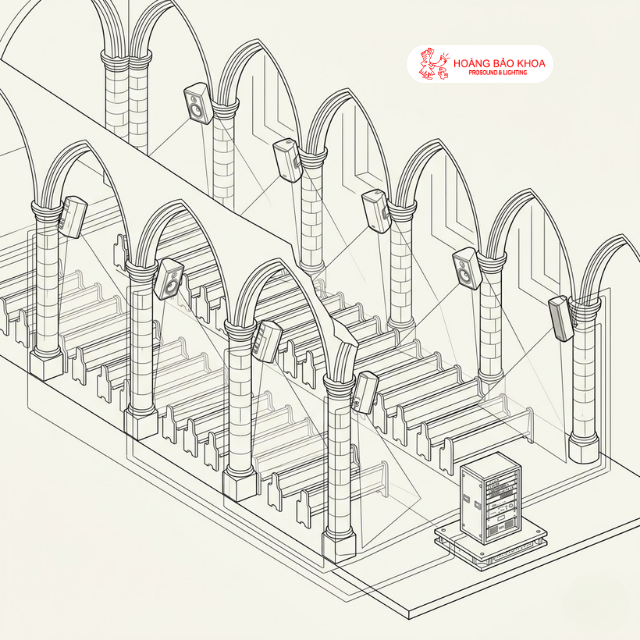
In a church that spans dozens of meters in length, sound from the main loudspeakers near the sanctuary requires time to travel throughout the congregation area. If auxiliary speakers or delay speakers reproduce the signal simultaneously with the main speakers without proper time alignment, listeners will receive multiple audio signals separated by only a few milliseconds.
Although this time difference is extremely small, it can significantly reduce speech intelligibility. Listeners may perceive the sound as echoing, unfocused, or may struggle to identify where the audio is actually coming from.
DSP is used to calculate the precise sound travel time between different speaker zones. It applies the appropriate delay to each speaker location, ensuring that sound reaches listeners more simultaneously. When configured correctly, the congregation perceives the audio as originating entirely from the sanctuary area, even though multiple speaker clusters are being used throughout the building.
This is one of the main reasons why large churches almost always require DSP processing to maintain consistent speech clarity from the front of the sanctuary to the furthest seating areas.
DSP Is Effective Only When Designed as Part of the Entire System
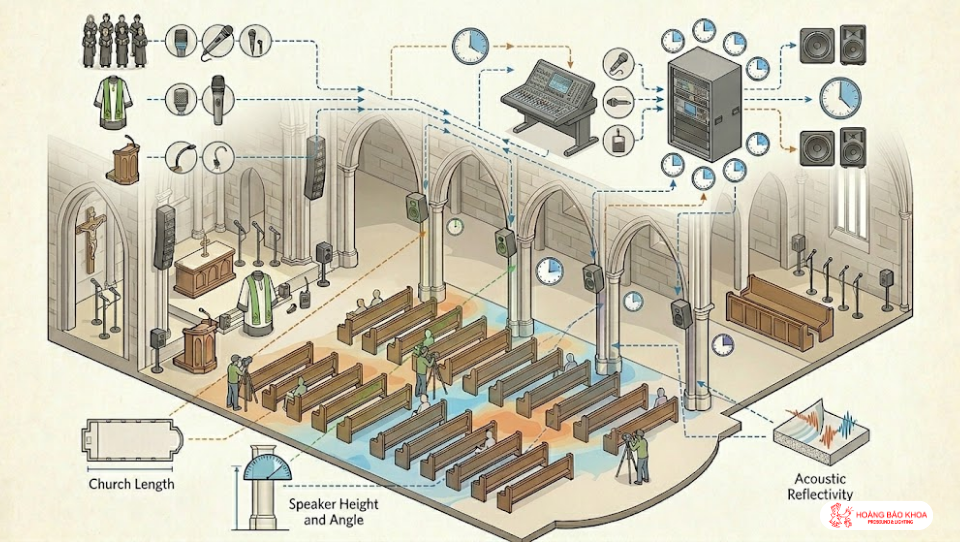
A common misconception is that simply purchasing a high-quality DSP will automatically improve system performance. In reality, DSP cannot completely compensate for shortcomings in system design.
Delay calculations depend on numerous factors, including church length, speaker placement, coverage angles, ceiling height, and the acoustic reflection characteristics of the building. As a result, two churches using the same DSP may require entirely different configurations.
In addition, input signal quality directly affects processing performance. In many worship audio projects, the system is designed as a complete solution that includes:
When these components operate together as an integrated system, the result is significantly improved speech intelligibility, better message delivery, and greater long-term reliability.
An Effective DSP System Begins with a Site Survey
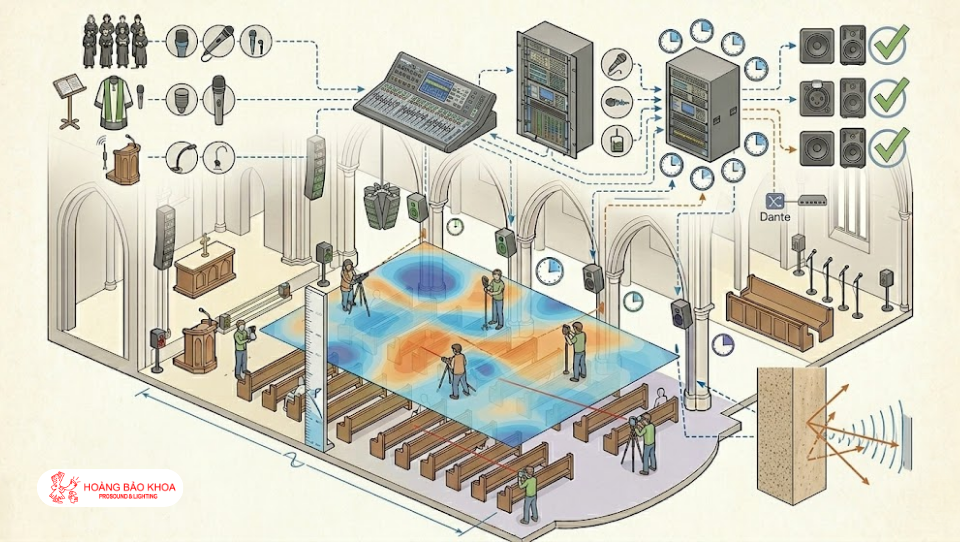
There is no universal DSP formula that works for every church. Each building has its own architecture, size, acoustic characteristics, and ministry requirements. This is why a thorough site survey is always more important than selecting individual products.
At Hoang Bao Khoa, the implementation of a church sound system typically begins with evaluating the existing installation, analyzing the acoustic environment, and identifying the practical needs of the congregation.
Based on this assessment, the technical team will:
- Design an appropriate loudspeaker system
- Determine optimal speaker placement locations
- Configure and calibrate DSP settings
- Select equipment that matches both budget and application requirements
Through this approach, the resulting solution is designed not merely to produce higher sound levels, but to help the congregation hear more clearly, understand spoken content more easily, and maintain reliable performance for many years to come.