In education, lecture content is the core, but audio is the “pathway” that delivers knowledge from lecturers to students. A poor-quality sound system not only causes discomfort, but also directly reduces comprehension effectiveness and leads to fatigue for instructors. Investing in a well-designed audio solution is, in essence, an investment in the quality of a school’s education and training.
Acoustic challenges in educational environments
A lecture hall is not a living room or a cinema. It is a space with highly specific and demanding acoustic requirements:
-
Large spaces with hard surfaces: Concrete walls, glass, and high ceilings create reverberation, causing speech to become blurred and difficult to understand.
-
High speech intelligibility (STI) requirements: In education, students must clearly hear every syllable, especially in foreign language classes or complex specialized subjects.
-
Continuous operation: The system must operate stably for 8–10 hours per day, requiring exceptional durability and reliability.
Modern solutions: Replacing “PA speakers” with a uniform sound coverage system
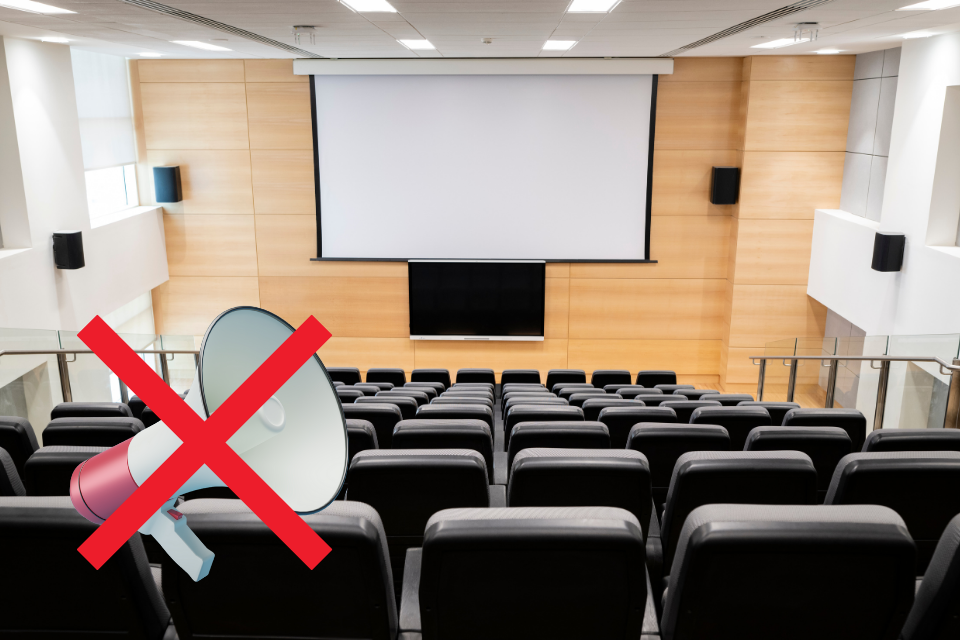
It is time to move beyond the approach of installing a few high-power speakers at the front of the room. Modern lecture hall audio solutions focus on precise and even sound distribution.
Distributed sound system
Instead of making the front seats uncomfortably loud while the back rows struggle to hear, the system uses column speakers or wide-dispersion ceiling speakers. Sound is evenly distributed throughout the space, ensuring all students receive a consistent listening level.
Microphones that support lecturers’ vocal health
.png)
High-quality lavalier Microphones or headset microphones allow lecturers to speak comfortably without raising their voice for extended periods. Noise filtering technology eliminates fan noise and background sounds, focusing solely on natural and clear speech.
Digital Signal Processing (DSP) - The heart of the system
The DSP processor functions as an automatic sound engineer, handling key tasks such as:
-
Automatically eliminating feedback-prone frequencies.
-
Balancing volume levels between lecturers with different vocal strengths.
-
Pre-configured operating modes for in-person teaching, hybrid learning, and video playback.
Benefits of a properly designed system from the start
-
Enhanced learning effectiveness: Students no longer need to strain to hear, allowing better focus on lecture content.
-
Ready for hybrid education: Seamless integration with Zoom, Microsoft Teams, and other online learning platforms with stable audio quality.
-
Simple operation: Lecturers can enter the room and turn on the system, with all settings pre-optimized and no complex adjustments required.
-
Long-term cost efficiency: Properly specified, genuine equipment minimizes failures and reduces annual maintenance costs.
Hoang Bao Khoa - A trusted partner in education
Hoang Bao Khoa does not simply supply equipment; we create professional acoustic environments for education. Our solutions for schools and universities follow a structured process:
-
Acoustic assessment: Measuring reverberation time and noise levels in the actual space.
-
Pre-installation testing: Allowing institutions to visualize sound coverage before deployment.
-
Installation and handover: Ensuring stable system performance and providing detailed user training.
Conclusion
A modern lecture hall deserves an audio system of equal standard. This is not merely an equipment upgrade, but a mark of respect for lecturers and a commitment to educational quality for students.