In live sound systems, tuning a line array using DSP (Digital Signal Processing) is a critical step in achieving consistent, clear sound from the stage area all the way to the back of the venue. Line array loudspeakers feature unique dispersion characteristics and are prone to complex phase interactions and interference, making precise DSP application essential for effective delay alignment, phase optimization, crossover configuration, and EQ adjustment.
When implemented correctly, DSP tuning helps the system reach optimal audio performance, minimizes unwanted reflections, and ensures a uniform listening experience across all audience areas. Explore the detailed guidance in this article to better understand the principles and best practices behind efficient line array tuning and setup.
1. Define clear objectives before tuning a line array
Before making any adjustments, define clear goals: intelligible vocals, even SPL distribution, smooth mid and high frequencies, and well-controlled low-end response. This helps establish a systematic tuning approach, avoiding random EQ or delay changes based solely on personal perception at a single listening position. A properly tuned Line Array system delivers accurate, consistent sound and reduces listener fatigue over long periods.
2. Prepare measurement tools and equipment
To tune a line array effectively using DSP, you need the right tools: a calibrated measurement Microphone, audio analysis software (such as Smaart, Room EQ Wizard, or DSP-integrated tools), and a distance meter or laser for precise delay calculations. In addition, a real-time analyzer (RTA) allows you to observe frequency response and energy distribution at multiple locations, ensuring all parameters remain under control.
3. Measure - adjust - repeat workflow
Line array tuning should follow a logical loop: measure the system, make adjustments, then measure again to verify results. The typical STEPS include:
- Confirm the position and rigging height of each Line Array module.
- Select the appropriate manufacturer DSP presets for the loudspeaker model.
- Measure SPL and frequency response at representative audience positions.
- Adjust delay, phase, crossover, and EQ, then re-measure for comparison.
- Repeat the process until the desired uniformity is achieved.
4. Configure line array geometry
Line array geometry determines how sound WAVES are distributed within the space. Adjusting splay angles between enclosures, rigging height, and overall curvature helps achieve more even coverage, minimizes hot and cold spots, and reduces comb filtering. Subwoofer placement should also be planned in advance to avoid low-frequency interaction issues.
5. DSP routing and preset configuration
Using manufacturer-approved presets helps prevent common issues such as excessive gain, incorrect polarity, or mismatched crossover settings. Verify gain structure from the mixing console to the amplifiers to maintain sufficient headroom and avoid clipping during the tuning process. This is a critical foundation before applying detailed EQ or delay adjustments.
6. Time alignment and delay
Time alignment is a key factor in Line Array tuning. Calculate delay based on the distance from each module to the listening area and apply it accurately in the DSP. Consider the speed of sound (approximately 343 m/s) and reflections from walls or ceilings to prevent phase misalignment. Proper delay alignment results in a clearer and more coherent system.
7. Phase coherence and polarity
Check phase relationships between array modules and subwoofers to avoid phase cancellation. Use test pulses to observe impulse responses and adjust polarity when necessary. Good phase alignment improves clarity and accuracy, especially in the mid and high frequency ranges.
8. Crossover strategy
The crossover defines how frequencies are divided between subwoofers and the mid/high array. Selecting appropriate crossover frequencies (typically 60 - 120 Hz for sub-to-main) and suitable slopes helps avoid overlap or frequency gaps while maintaining phase consistency across system components.
9. EQ: cut first, limit boosting
When tuning a line array, prioritize cutting problematic resonances or feedback-prone frequencies and limit excessive boosting. Notch filters are useful for removing unwanted frequencies, but avoid forcing a perfectly flat response based on a single measurement point. Well-applied EQ results in a more natural sound that remains consistent throughout the venue.
10. FIR vs IIR filters
Understanding the advantages and limitations of FIR and IIR filters is essential when tuning a Line Array:
- FIR filters: linear phase response and precise alignment, but introduce higher latency and require more DSP resources.
- IIR filters: low latency and easy to implement, but can affect phase when applied aggressively.
Select the appropriate filter type based on tuning objectives and available DSP capacity.
11. Subwoofer integration and cardioid arrays
Subwoofers must be integrated accurately with the line array to prevent phase cancellation and uneven SPL distribution. Cardioid subwoofer arrays help control rearward energy, which is particularly important for indoor venues or outdoor events near residential areas.
12. Verify coverage with multiple measurement points
Measure SPL and frequency response at multiple locations throughout the venue, from front-of-house to areas far from the stage. Averaging multiple measurements prevents tuning decisions based on a single position and ensures consistent coverage, reducing hot spots and dead zones.
13. Common mistakes
- Over-EQing: forcing a perfectly flat curve leads to instability.
- Incorrect splay angles: results in uneven coverage and hot/cold zones.
- Measuring only at FOH: other audience areas are neglected.
- Incorrect delay or phase alignment between sub and main arrays: causes cancellation and loss of bass and midrange.
14. Pre-show checklist
- Verify DSP presets and firmware.
- Confirm correct polarity and gain structure.
- Measure and align subwoofers.
- Set initial crossover and EQ.
- Spot-check multiple locations using a measurement microphone and reference headphones.
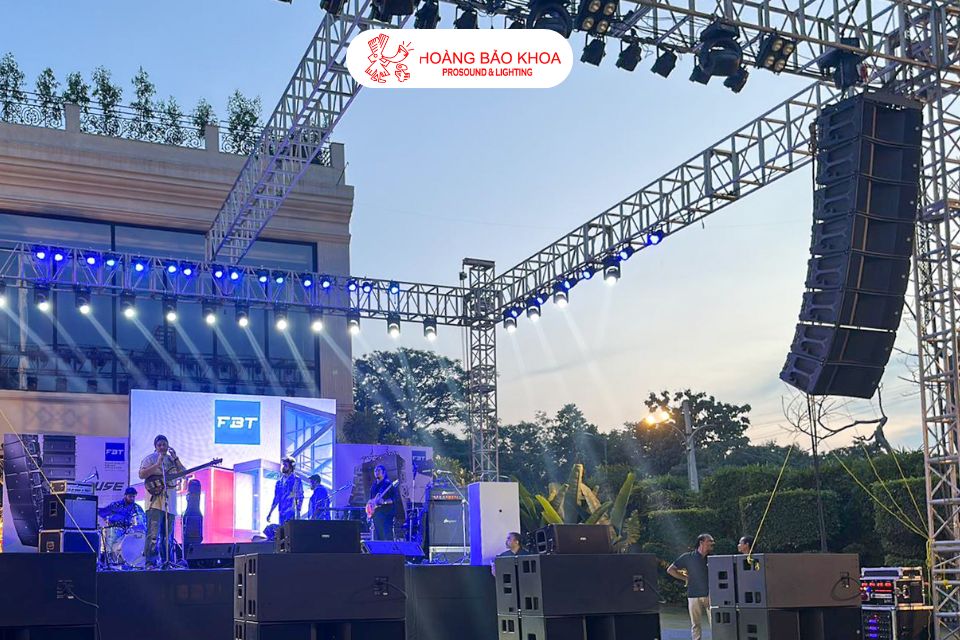
High-performance Line Array solutions for large-scale stages: FBT MYRA
In professional stage sound systems where high SPL, consistent coverage, and precise phase control across the full frequency range are required, FBT MYRA has been developed as a high-performance line array series for touring and large-scale productions. Its modular design, rigging system, and DSP-oriented architecture focus on system-wide coherence, allowing engineers to maintain consistent geometry, time alignment, and subwoofer integration in real-world deployments.
In Vietnam, FBT MYRA line array systems are officially distributed by Hoàng Bảo Khoa, making them suitable for stage projects, festivals, and professional performance systems that demand large-scale configurations, stable operation, and clearly defined technical standards.