Many churches continue to experience issues such as lower sound levels, reduced speech intelligibility, or a sense of echo and unnatural sound in the rear seating areas, even after upgrading their loudspeaker systems. In many cases, the problem is not the quality of the loudspeakers themselves, but rather a system design that does not adequately account for the length of the building. This is where the use of delay loudspeakers should be considered as part of the overall sound system design.
Delay Speakers Are Not Meant to Make the Sound Louder
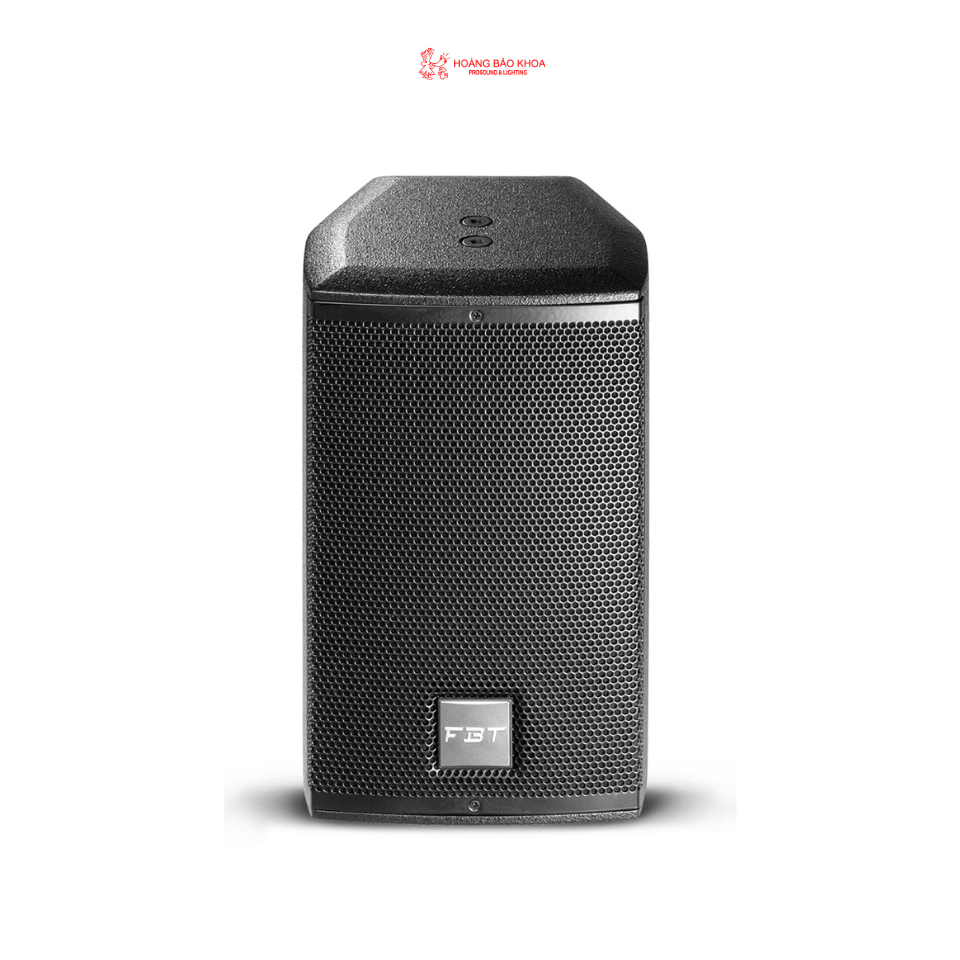
One of the most common misconceptions is that delay speakers are used to increase system power or make the sound louder.
In reality, the opposite is true.
The primary purpose of delay speakers is to distribute sound more evenly throughout the entire church.
In large worship spaces, sound from the main speakers located near the sanctuary must travel a considerable distance before reaching listeners seated at the rear.
During this process:
- Sound pressure decreases as distance increases
- Reflections from walls and ceilings become more prominent
- Speech intelligibility is significantly reduced
This is why many parishioners seated at the back can still hear the sound but struggle to clearly understand the sermon or spoken message.
Delay speakers are installed at intermediate locations to bring sound closer to listeners. They are carefully time-aligned with the main speaker system so that the audio appears to originate from a single source.
When properly designed, most listeners will not even notice the presence of delay speakers, yet they will experience clearer and more natural sound throughout the space.
Signs That a Church May Need Delay Speakers
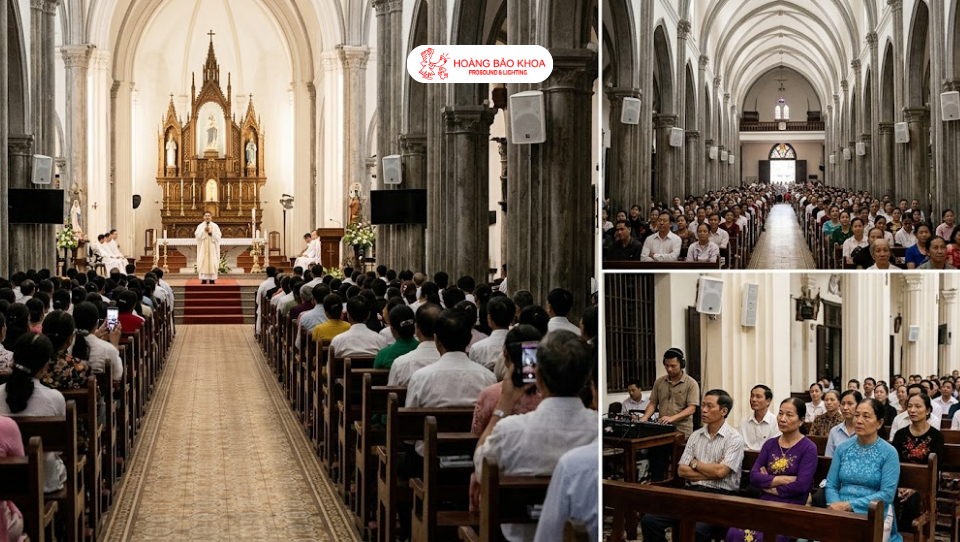
Not every church requires a delay speaker system.
However, if your facility experiences any of the following issues, it may be worthwhile to evaluate the current audio system:
- Parishioners seated at the rear frequently report difficulty understanding sermons
- There is a significant volume difference between the front and rear seating areas
- Audio operators regularly increase system volume to accommodate listeners at the back
- Speech sounds distant, reverberant, or unclear in areas far from the sanctuary
- The building has a long floor plan or a large seating capacity
In many real-world installations, churches have significantly improved speech clarity simply by adding delay speakers and properly tuning the system, without replacing their existing equipment.
Delay Speakers Are Effective Only When Properly Integrated
Another common mistake is assuming that simply installing additional speakers at the rear of the church will solve coverage problems.
In reality, the effectiveness of a delay speaker system depends on several critical factors:
- Speaker placement
- Coverage angle
- Sound pressure level
- Distance between speaker zones
- Accurate delay-time calculations
If these parameters are not properly configured, the system may suffer from overlapping audio, phase issues, or reduced speech intelligibility rather than improved performance.
This is why, in church audio projects, system design and site evaluation are often more important than selecting individual products.
At Hoang Bao Khoa, the technical team evaluates the entire facility before recommending a solution. Factors such as church length, ceiling height, congregation capacity, sanctuary location, and acoustic characteristics are carefully analyzed to create a system tailored to the specific building.
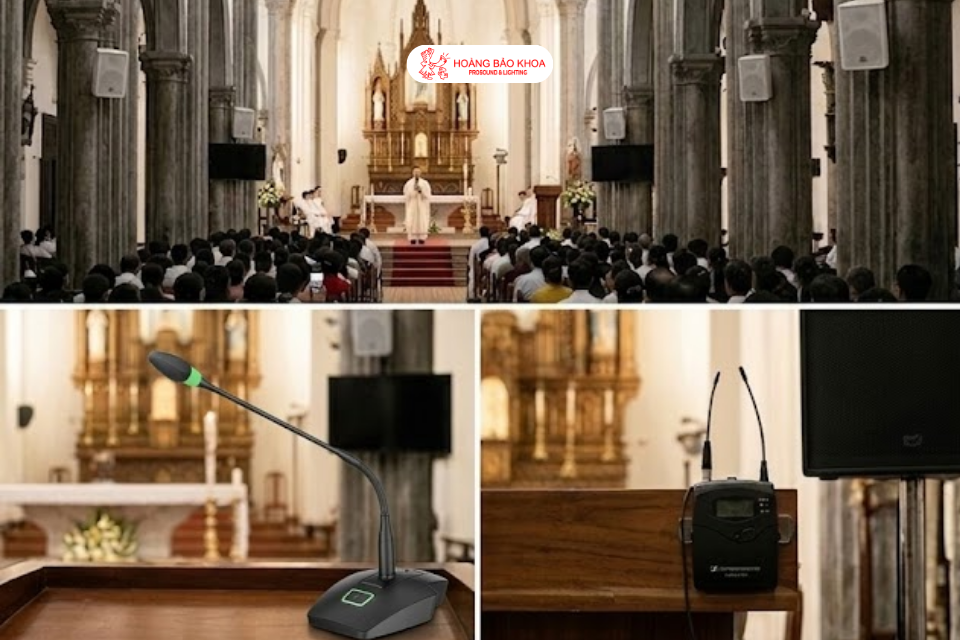
Depending on project requirements, the system may incorporate installation loudspeakers from TANNOY or FBT to optimize coverage and speech intelligibility.
Input signal quality is equally important. Solutions such as Sennheiser wired Microphones for choirs, Sennheiser wireless systems paired with Neumann KMS capsules for clergy, and Bizcom gooseneck microphones for scripture lecterns help ensure consistent and reliable system performance.
Conclusion
Delay speakers are not designed to make a sound system louder. Their purpose is to provide more even coverage and better speech clarity in long worship spaces.
However, the success of a delay speaker system depends not on the number of speakers installed but on the overall system design. Site evaluation, speaker placement, DSP optimization, and proper equipment selection all play critical roles in achieving the best possible audio performance.
For churches and chapels experiencing poor intelligibility in rear seating areas or uneven sound coverage, a comprehensive system assessment should be the first step before investing in additional equipment.