Many parishes invest hundreds of millions, or even billions, of Vietnamese dong in their sound systems, yet still receive familiar feedback such as: "speech is unclear," "the sound is too reverberant," "the choir lacks balance," or "the microphones frequently cause feedback." This highlights an important reality: audio performance depends not only on the quality or cost of the equipment, but also on how the entire system is designed, integrated, and implemented.
Good Equipment Does Not Always Create a Great Sound System
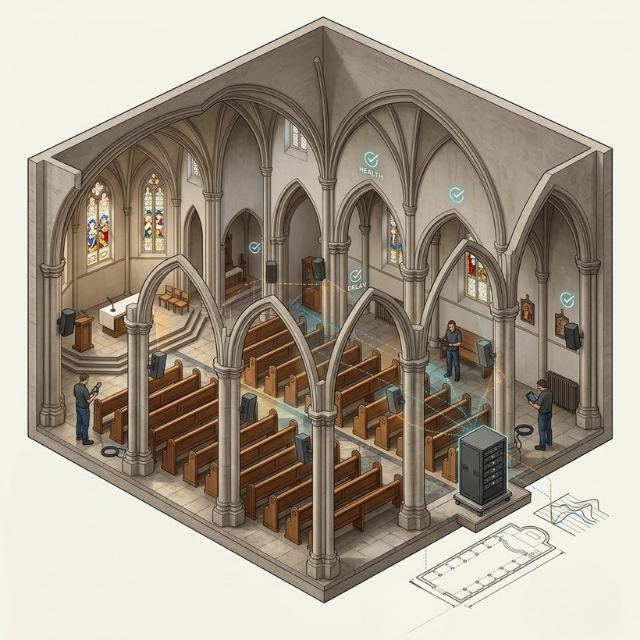
One of the most common mistakes is focusing too heavily on equipment brands or power ratings while overlooking the overall system design.
In practice, many churches use high-quality loudspeakers, yet their placement may not be suitable for the building's architecture. Sound may be well distributed in one area but lack clarity in another. Likewise, even the best Microphones cannot deliver their full potential if the signal processing chain and loudspeaker system have not been properly optimized.
In a worship environment, the primary goal is not louder sound but greater speech intelligibility. The congregation needs to clearly hear every reading, homily, prayer, and announcement. Therefore, equipment selection must be combined with careful planning of sound coverage, loudspeaker aiming, acoustic reflection control, and the architectural characteristics of the church.
This is also why two churches using similar equipment can achieve completely different audio results.
An Effective Sound System Is the Combination of Multiple Components
The final audio quality experienced by the congregation is the result of the entire system working together, not a single piece of equipment.
The audio source must be clear and reliable. Many churches today choose:
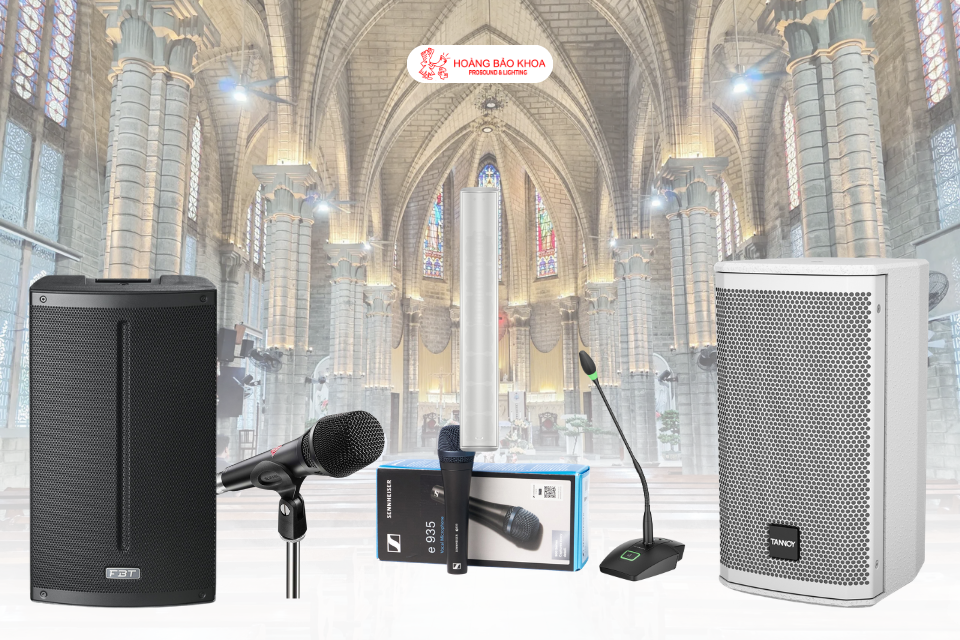
- Sennheiser wired microphones for choir applications to reproduce vocals naturally and with greater detail
- Sennheiser wireless systems combined with Neumann KMS capsules for clergy, offering clear and consistent speech reproduction
- Bizcom gooseneck Microphones for scripture reading lecterns, providing focused pickup and convenient operation
Beyond the microphones, the system also includes signal processing, DSP, and loudspeaker arrays. Depending on the project requirements, TANNOY or FBT installation loudspeakers may be selected to meet coverage and speech intelligibility objectives.
When any part of this chain performs below expectations, the effectiveness of the entire system is affected.
The Most Important Step Is Proper Survey and Design from the Beginning
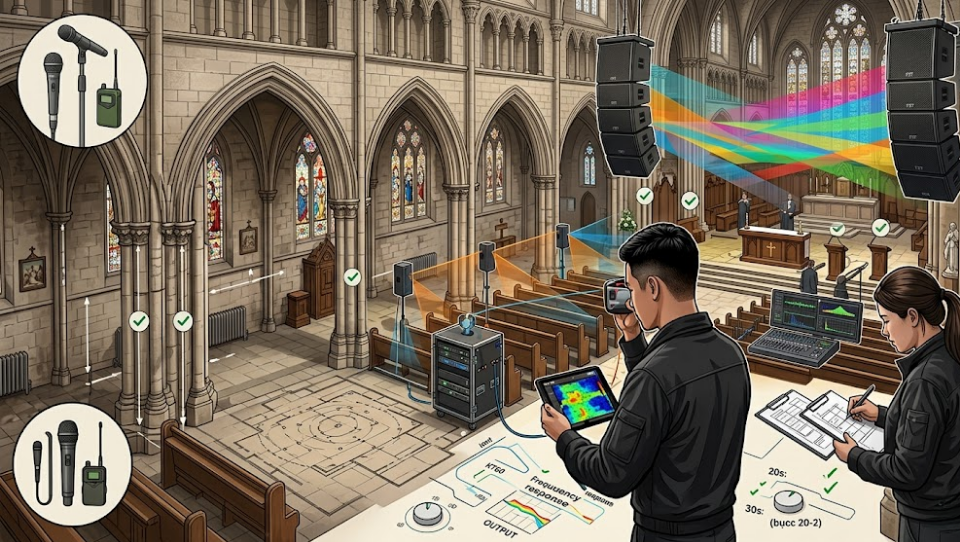
Through numerous church audio projects, Hoang Bao Khoa has found that many common sound system issues can be avoided when proper site surveys and system design are completed before installation.
A professional survey helps evaluate:
- The architectural characteristics of the building
- The level of acoustic reflections
- Equipment installation locations
- Congregation size and seating capacity
- Current and future usage requirements
Based on this information, the technical team can develop a customized solution instead of applying the same configuration to every church.
This is why many churches achieve excellent audio performance without using the most expensive equipment. Conversely, a system with a high investment cost can still experience limitations if the design process lacks proper planning and calculation.
Conclusion
A great church sound system is not determined by the value of its equipment but by how effectively all components work together. Site surveys, system design, proper equipment selection, and professional tuning are the key factors that help the congregation hear more clearly and enhance the overall worship experience.
Therefore, before investing in or upgrading a church audio system, parishes should evaluate the entire facility and identify the most appropriate solution rather than focusing solely on replacing or adding equipment.