The Neumann KH 150 is a two-way active monitor designed to fill the gap between the compact KH 120 and the larger three-way KH 310. Combining a 165mm bass/mid driver, 25mm tweeter, onboard DSP and integration with MA 1, the KH 150 delivers extended bandwidth, substantial output capability and precise monitoring from a relatively compact nearfield design.
Where the KH 150 Fits in the Neumann Monitor Range
Within Neumann's monitor range, the KH 150 sits between the compact two-way KH 120 and the significantly larger three-way KH 310. It addresses applications where the KH 120 may not provide sufficient bandwidth or volume capability, without moving up to the larger KH 310.
The KH 150 follows the established design language of Neumann Professional Studio Monitors while incorporating advanced electro-acoustic engineering and extensive DSP processing.
Two-way Design with a 165mm Bass/Mid Driver
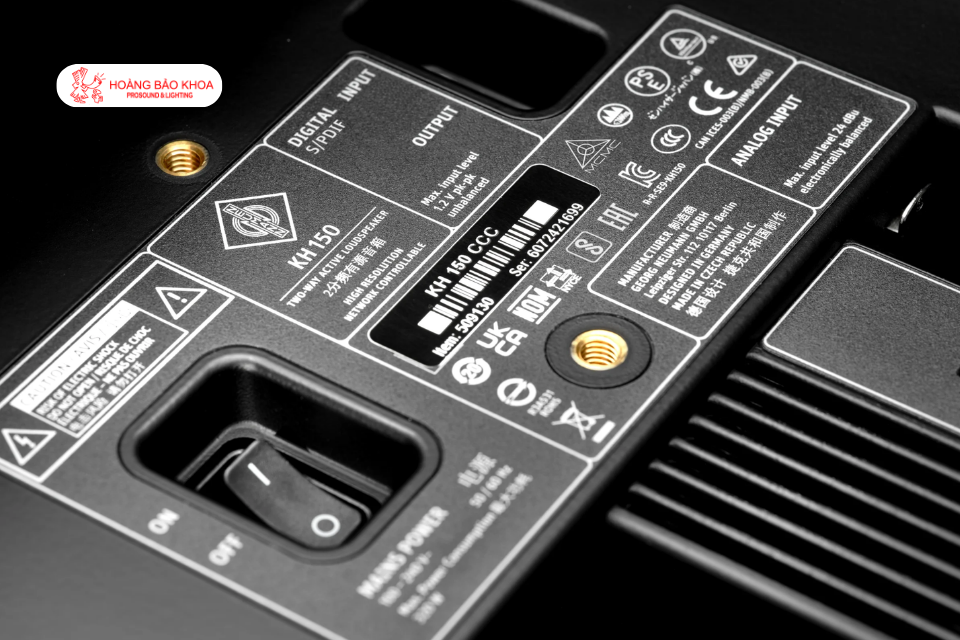
The KH 150 is one of the Neumann Nearfield Studio Monitors built around a two-way configuration. It combines a nominally 165mm bass/mid driver with a 25mm tweeter loaded by an elliptical waveguide.
The enclosure combines composite polycarbonate front and rear mouldings with a wooden carcass. Softened cabinet edges and the smoothly integrated waveguide help minimise response irregularities caused by diffraction.
The newly developed bass/mid driver provides ±12mm of linear diaphragm travel. It uses a paper diaphragm and dust cap with a rubber roll surround.
The 25mm tweeter employs Neumann's Mathematically Modelled Waveguide. The crossover frequency is 1.7 kHz, which is relatively low for a similarly configured two-way monitor and helps achieve better directivity matching between the drivers around the crossover region.
DSP at the Core of the KH 150
DSP plays a significant role in both the inherent electro-acoustic performance of the KH 150 and its integration with the listening environment.
A bass/mid driver limiting function prevents diaphragm displacement from exceeding ±12mm. DSP also provides fine adjustment of the individual driver responses, ensuring no more than ±0.8dB divergence between monitors, while implementing fourth-order crossover slopes and wide-band phase correction.
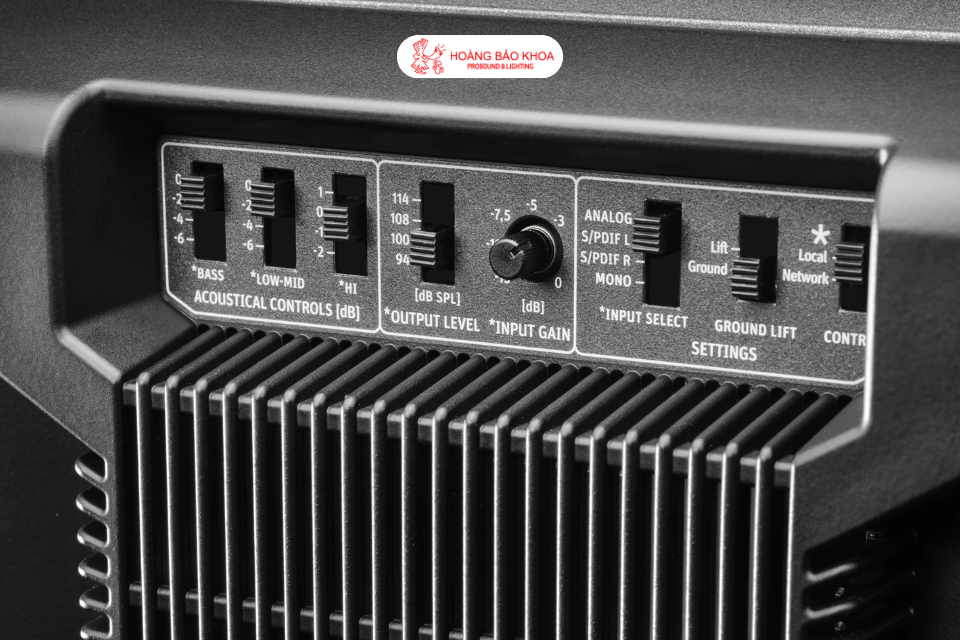
In Local mode, the KH 150 operates like a conventional Neumann Active Studio Monitor, with rear-panel controls for input selection, ground lift, input sensitivity, gain and three EQ bands.
Integration with Neumann MA 1
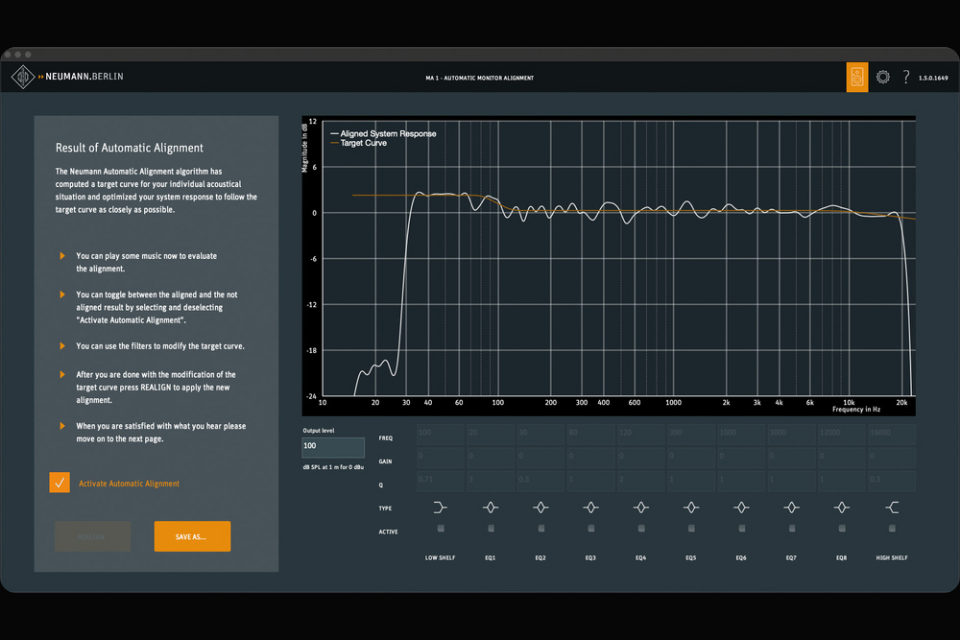
The KH 150 is fully integrated with Neumann's MA 1 monitor alignment technology. The MA 1 package combines an individually calibrated measurement Microphone with a Mac- and Windows-compatible analysis and control application.
The calibration procedure uses seven sine- WAVE sweeps captured with the measurement microphone at several positions focused around the primary listening position.
MA 1 analyses the acoustic characteristics of the room and the way the monitors interact with it, then creates equalisation data intended to optimise performance at the listening position.
Once the process is complete, the optimisation data is uploaded to the monitors, allowing them to operate without remaining connected to the network.
Extended Low-frequency Performance
The KH 150 employs two reflex ports tuned to 42 Hz. Their triangular, flared design is intended to maintain laminar airflow at high playback levels while minimising unwanted resonances.
The specified low-frequency bandwidth reaches -3dB at 39 Hz. The maximum low-frequency level between 50 and 100 Hz at 3 percent total harmonic distortion is 107.5 dB.
These figures demonstrate substantial low-frequency capability for a relatively compact member of the Neumann Studio Monitor Speakers range.
Analogue, S/PDIF and AES67 Connectivity
The standard KH 150 provides conventional balanced analogue and S/PDIF digital inputs.
The KH 150 AES67 version adds Audio over IP network connectivity compatible with AES67-compliant protocols such as Ravenna and Dante.
Following its inputs and 48kHz/24-bit A-D conversion for analogue signals, the KH 150 provides 145 Watts of amplification for the bass/mid driver and 100 Watts for the tweeter.
Sound On Sound Measurements
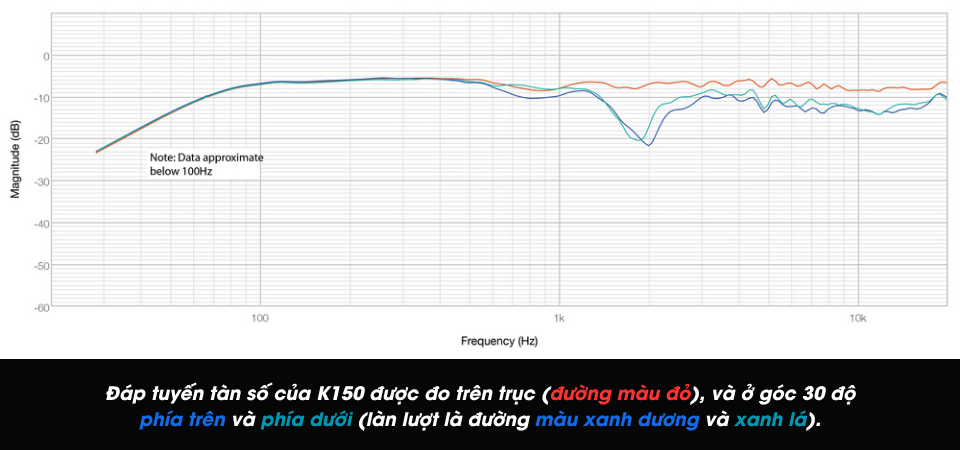
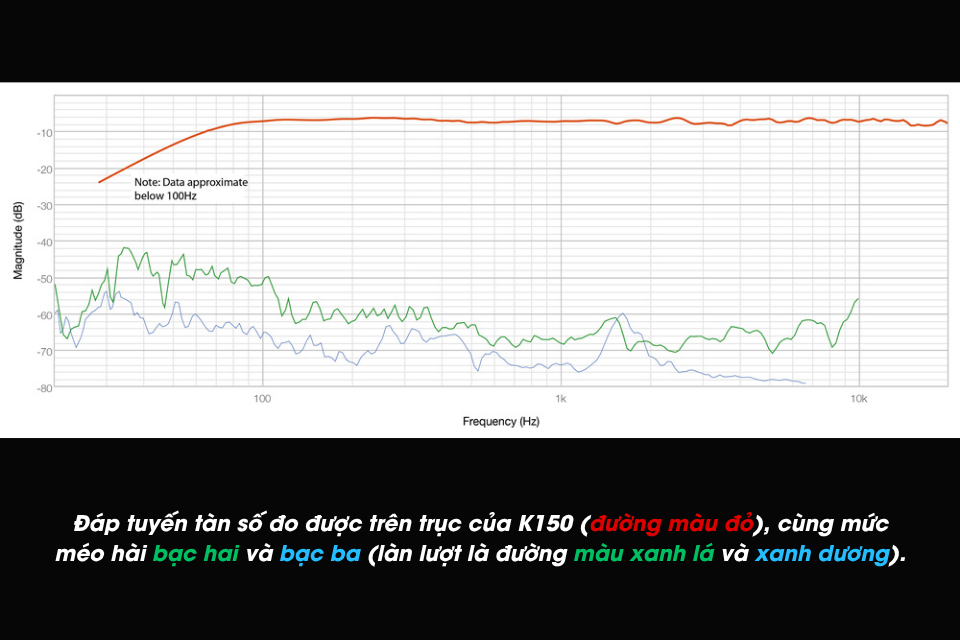
In Sound On Sound's measurements, the KH 150's on-axis frequency response remained within ±1dB from 100 Hz to 20 kHz. The reviewer described it as probably the flattest frequency response he had measured on a commercially available loudspeaker.
Harmonic distortion performance was similarly notable. Second-harmonic distortion was typically around -50 to -55 dB, while third harmonic was generally another 5 to 10 dB lower.
Off-axis measurements also indicated well-managed integration between the two drivers through the crossover region.
Listening to the KH 150
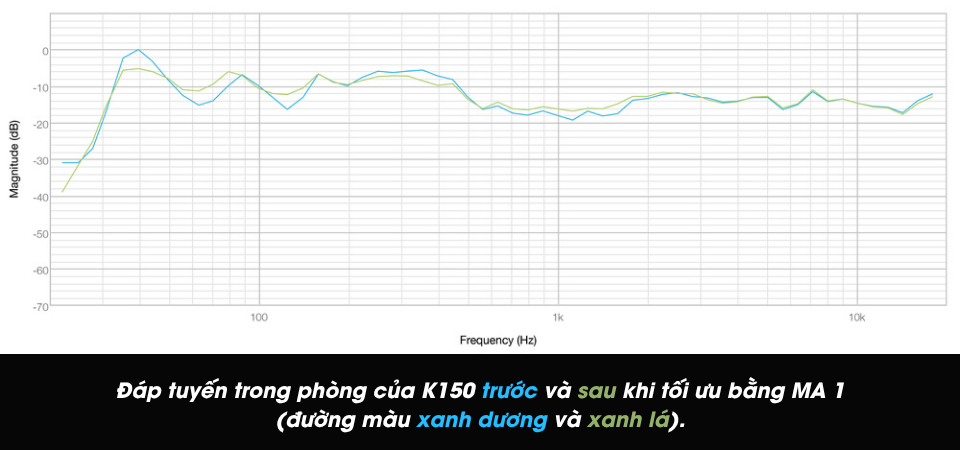
With the KH 150 operating in Local mode without MA 1 optimisation, Sound On Sound found that its flat frequency response, controlled dispersion, very low distortion, wide bandwidth and significant output capability combined to create a highly analytical monitoring tool.
Stereo imaging was stable, mix clarity was high, and the tonal character remained consistent across different listening levels. Bass extension was also notable considering the monitor's relatively compact dimensions.
Adding MA 1 further sharpened stereo imaging, revealed additional mix detail and reduced the influence of room acoustics on tonal balance and coloration.
Sound On Sound concluded that the KH 150 and MA 1 demonstrate what can be achieved by combining advanced electro-acoustic engineering with DSP.
Experience the Neumann Monitoring Ecosystem at Hoang Bao Khoa
Alongside the KH 150, users can explore the wider Neumann Studio ecosystem at hoang bao khoa.
The space also provides an opportunity to experience Neumann Studio Equipment in a practical studio environment, including monitoring systems and equipment used within recording workflows.
Source: Sound On Sound – Neumann KH 150