The KH 80 DSP and KH 120 II are active Neumann studio monitors with different cabinet sizes, bass extension and output capability. This comparison covers their published specifications, room calibration and recommended listening distances to help you choose a model for your room, listening position and production workflow.
Neumann Studio Equipment: Key Differences
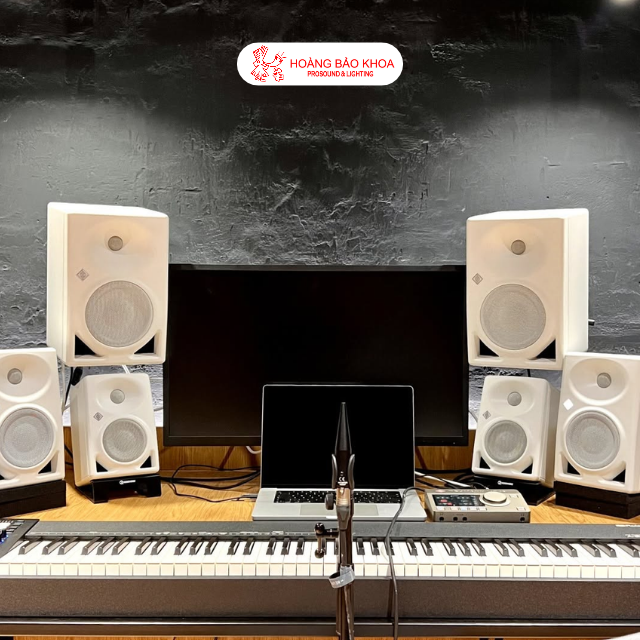
Both are Neumann Studio Monitors with onboard DSP and support for MA 1 room alignment. The KH 80 DSP uses a 4-inch woofer in a compact cabinet; the KH 120 II uses a 5.25-inch woofer. Neumann’s specifications show the KH 120 II reaching lower in the bass and delivering a higher maximum SPL under the listed test conditions. These differences matter when you need more low-frequency information or additional headroom.
Professional Studio Equipment: Specification Comparison
| Specification |
KH 80 DSP |
KH 120 II |
| Woofer |
4 inches |
5.25 inches |
| Free-field frequency response, ±3 dB |
57 Hz–21 kHz |
44 Hz–21 kHz |
| Maximum SPL, full space, 3% THD |
102.8 dB SPL |
110.8 dB SPL |
| Recommended listening distance |
0.75–2.0 m |
1.0–2.0 m |
| MA 1 room alignment |
Yes |
Yes |
| Analog input |
XLR / 6.3 mm TRS |
XLR |
The SPL figures are Neumann’s full-space values averaged from 100 Hz to 6 kHz at 3% THD. Compare them only with measurements using the same method. The KH 120 II also provides S/PDIF digital input, while the KH 80 DSP accepts balanced analog input through XLR or 6.3 mm jack.
Nearfield Studio Monitors: Matching the Room
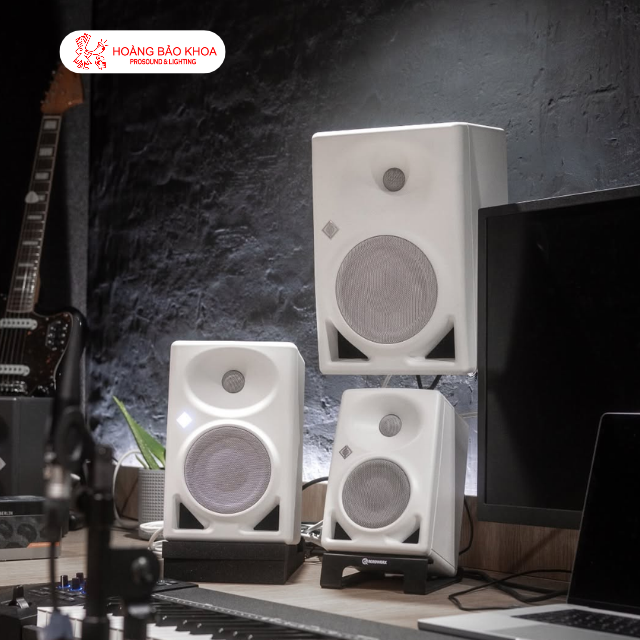
For Neumann Studio Monitor Speakers, listening distance and placement should suit the room. Neumann recommends 0.75–2.0 m for the KH 80 DSP and 1.0–2.0 m for the KH 120 II. Based on cabinet size, bass extension and output specifications, the KH 80 DSP may be easier to place at a close desktop position; the KH 120 II may suit a setup that needs deeper bass response or more output headroom. This is an inference from the published specifications, not a guarantee for every room.
Both models support automatic room alignment through MA 1. Calibration can help adapt the response at the listening position, but it does not replace basic acoustic treatment. Place the speakers symmetrically, form a balanced listening Triangle and manage early reflections before running room correction.
Professional Recording Studio: Choosing Between the Models
If you work in a small room, sit close to the speakers and usually monitor at moderate levels, the KH 80 DSP is a practical option to audition. If you need more low-frequency extension and output capability, the KH 120 II has an advantage in the published specifications. For Neumann Professional Studio Monitors, compare both at matched playback levels with familiar reference tracks, especially vocals, kick and bass.
Hoang Bao Khoa is an official Neumann distributor and authorized service center in Vietnam. Contact the team for advice based on your room size and monitoring needs.